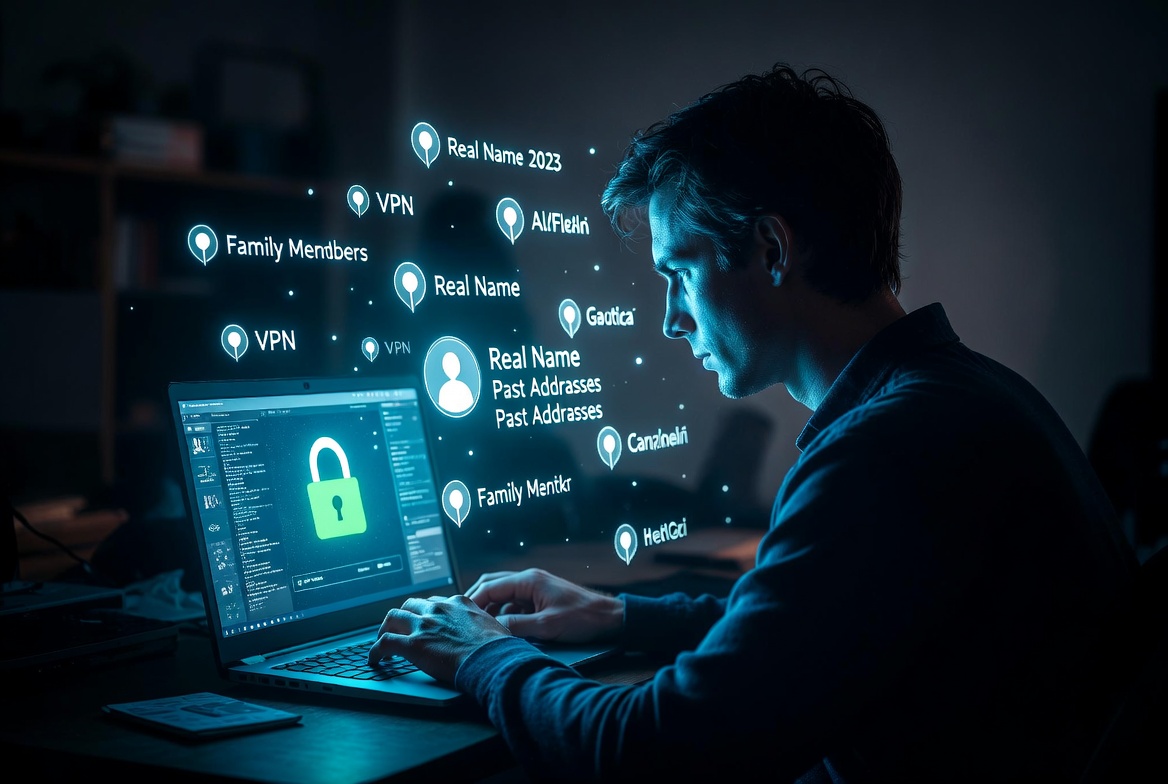
The Illusion of Invisibility
There is an epidemic of overconfidence in the cybersecurity and urban survival community. You have read our Zero Trust VPN guide, you have subscribed to a true no log VPN on the market, your traffic is encrypted in AES-256, and your IP address is spoofed to Switzerland. You feel untouchable. You think you are a ghost.
This is a deadly illusion.
If you are wondering why a VPN does not protect you from data brokers, the answer is brutal: a VPN masks what you are doing today, but it cannot erase what you did yesterday.
To Data Brokers and OSINT (Open Source Intelligence) experts, your VPN is entirely irrelevant.
What a VPN Does (and Does Not Do)
Let’s be clear: a VPN is a mandatory tool. It creates a secure tunnel between your device and the internet, preventing your Internet Service Provider (ISP) or the hacker at the local coffee shop from sniffing your live traffic or stealing your passwords.
But why a VPN does not protect you from data brokers? Because Data Brokers do not hack your current connection. As seen in the Doxxing Nightmare SHTF scenarios or through Swatting attacks, your physical security is compromised through public databases. They vacuum up historical, legal data.
- A VPN does not mask the physical address you provided to have a package delivered in 2017.
- A VPN does not encrypt public voter registries, marriage records, or public insurance databases.
- A VPN does not erase your phone number from the massive database leaks (like Facebook or LinkedIn) that have occurred over the last decade.
The Legal Black Market of Your Life
Massive corporations like Whitepages, Spokeo, MyLife, or Experian spend their days aggregating these digital breadcrumbs. They compile these terabytes of raw data to build terrifyingly accurate “shadow profiles,” including your past and present addresses, the names of your relatives, your phone numbers, and sometimes your income bracket.
These profiles are then legally sold to anyone willing to pay 5 or 10 dollars. This is the raw material for Doxing and Swatting attacks.
A stalker, a radical political activist, or a burglary ring does not need to crack your VPN encryption to find you. They just type your real name or an old online pseudonym into one of these search engines to get your exact GPS coordinates.

The Real Solution: Digital Scrubbing
Understanding why a VPN does not protect you from data brokers is the first step toward genuine Operational Security (OpSec). The second step is going on the offensive.
Since cryptography cannot save you here, you must remove the raw material from the market. You must legally force these brokers to delete your profile. This is called “Data Scrubbing.”
You can do this manually by sending dozens of individual Opt-Out emails along with copies of your ID, but the brokers will simply recreate your profile a few months later.
The only viable, long-term tactical method is to automate this continuous cleanup with professional services. As we detailed in our comprehensive DeleteMe review for privacy protection, this type of tool is your “VPN for the physical world.” It employs legal experts and algorithms to continuously purge your data from public databases, making a stalker’s job almost impossible.
In the Field: “The Dawn of Resilience”
In the world of The Dawn of Resilience, the separation between the physical and the digital has vanished.
For the inhabitants of the Zero Trust Village, using encrypted networks is standard procedure. But Ethan knows perfectly well that if he leaves his real name or old address lingering in corporate databases, the militia’s drones won’t even need to trace his IP. They will simply knock on his family’s door. Systematic public record erasure is the baseline doctrine before a secure router is even turned on.
OpSec is an Ecosystem
Stop believing in silver bullets. A True No Log VPN protects your data in transit. A Cold Wallet protects your finances. And a Data Scrubbing service (DeleteMe) protects your physical identity. And if you build your own digital sanctuary, an offshore provider like 1984 Hosting protects your infrastructure.
If you omit any of these pillars, you leave the front door to your sanctuary wide open.
Ready to Take Back Total Control?
Mastering your digital hygiene is not paranoia; it is the prerequisite for sovereignty in the 21st century. To understand the urgency of this preparation and see how a society resists absolute surveillance, dive into The Dawn of Resilience.
This survival manual disguised as a cyberpunk thriller will give you the keys to understanding the flaws of the modern system, and how to extract yourself from it.
