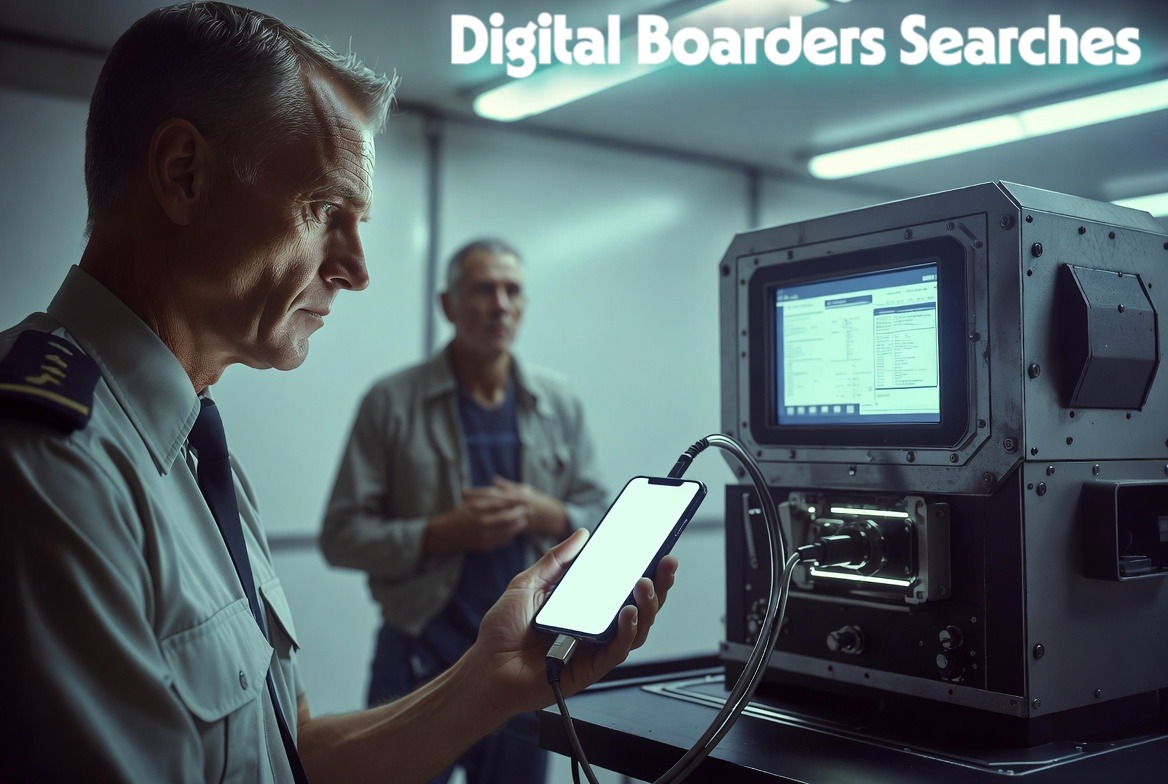
For decades, crossing an international border meant subjecting your physical luggage to search. Today, the contents of your suitcase are often the least of your concerns. The true target for customs agencies worldwide is the device in your pocket.
Digital border searches have surged in recent years. Agencies like the U.S. Customs and Border Protection (CBP) and their global equivalents operate in a unique legal gray area where standard constitutional protections against unreasonable search and seizure are significantly diluted.
In this article, we will examine the reality of digital border searches, why relying on software passwords is a critical failure, and how utilizing physical Faraday isolation is the only way to assert your sovereignty when crossing international lines.
The Reality of the Border “Chokepoint”
As we outlined in our initial guide on Airport Cybersecurity, border control zones are designed to strip you of your privacy.
When a customs officer asks to inspect your smartphone or laptop, they are not just looking for contraband photos. They are conducting a “basic search,” which legally permits them to scroll through your local files, text messages, contacts, and offline emails.
If they develop a “reasonable suspicion,” this can escalate to an “advanced search.” In this scenario, your device is confiscated and connected to a forensic extraction device (like a Cellebrite machine). These machines are designed to bypass standard locks, recover deleted files, and clone the entire hard drive of your device in minutes.
The danger is immense. You are not just risking your personal photos; if you are a business traveler, you are exposing sensitive corporate communications, attorney-client privileged information, and proprietary financial data to a foreign government database.
The Cloud Loophole and Live Devices
One of the most critical vulnerabilities during a border crossing is presenting a “live” device.
Legally, border agents are generally only permitted to search data that is physically stored on the device itself. They are typically not allowed to use your device to pull down data stored remotely in the cloud (like refreshing your email inbox or downloading files from a remote server during the search).
However, if your device is powered on and connected to the airport’s cellular or Wi-Fi network, your apps will automatically pull data from the cloud in the background. If an agent happens to see a notification pop up, or if an app syncs a sensitive document while they are holding the phone, that data is now legally considered “on the device” and subject to search and seizure.
Furthermore, a live device is susceptible to biometric unlocking. In many jurisdictions, law enforcement can legally compel you to use your fingerprint or FaceID to unlock a phone, whereas compelling you to provide an alphanumeric passcode often requires a higher legal standard or a court order.
The Executive Standard: Faraday Isolation
To survive the border chokepoint without compromising your data, you must adopt an uncompromising physical protocol: Hard Power Off and Faraday Isolation.
Well before you enter the customs hall, you must completely power down your devices. This flushes the RAM, forces the operating system into a “Data at Rest” encrypted state, and disables all biometric unlocking features.
Immediately after powering down, place the devices into a military-grade SLNT Faraday bag.
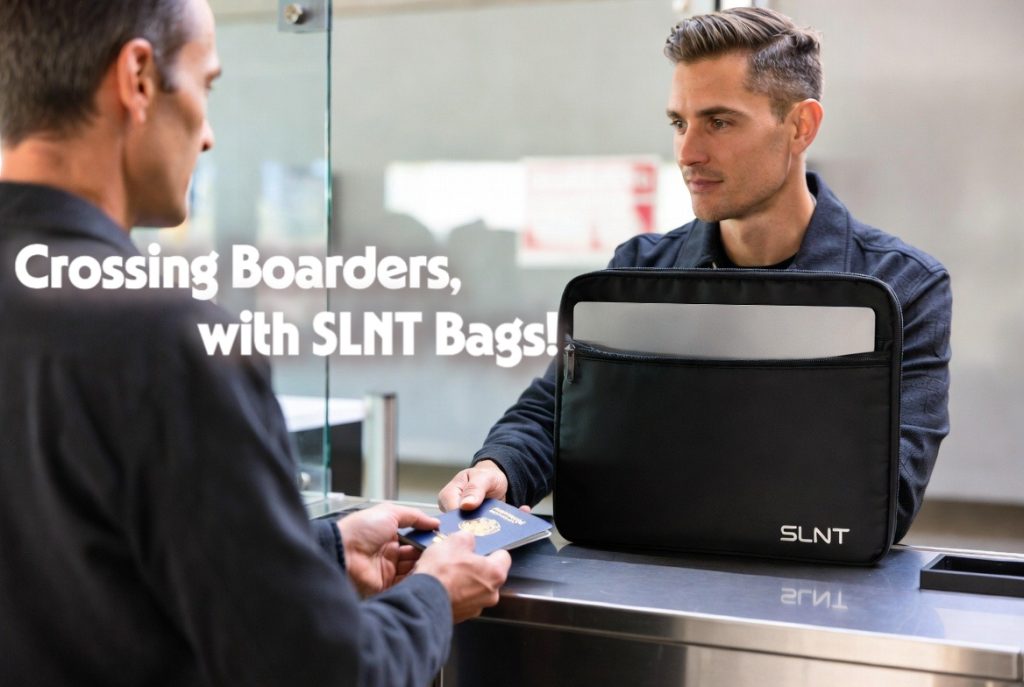
This physical shielding achieves three critical operational objectives:
- Network Denial: It guarantees that the device cannot accidentally turn on in your bag, connect to an airport network, and download cloud data while you are waiting in line.
- Remote Wiping Prevention: It prevents any actor—whether a hostile government or a malicious hacker in the terminal—from remotely triggering a device wipe or initiating a wireless attack while your hardware is out of your hands.
- Psychological Deterrence: Placing your electronics in a SLNT Faraday sleeve is a powerful visual statement. It signals to border agents that you are a hard target who understands operational security. It forces any inspection to be deliberate, formal, and legally sound, rather than casual and opportunistic.
🛡️ The Arsenal: Control Your Perimeter
Do not hand over the keys to your entire digital life at a border crossing. Shield your devices, force encryption at rest, and cross international lines with absolute confidence.
👉 Discover our selection of premium SLNT Faraday Bags in The Arsenal
FAQ: Navigating Digital Border Searches
What happens if I refuse to unlock my phone for a border agent?
The consequences depend on your citizenship status and the specific country. If you are a citizen, you generally cannot be denied entry to your own country, but your device may be confiscated for weeks or months for a forensic search. If you are a foreign visitor, refusing to unlock a device can result in immediate denial of entry and deportation.
Should I just use a “burner” phone when traveling?
Using a clean “burner” device (like a degoogled phone with minimal data) is an excellent strategy for high-risk travel. However, even a burner phone can be tracked via its IMEI number or compromised by airport scanners. Regardless of the device type, it should remain sealed in a SLNT Faraday bag whenever it is not actively and securely in use.
Will taking my laptop out of a Faraday bag for X-ray screening compromise it?
During standard security screening, you must remove laptops from dense bags. However, because your device is completely powered down (Hard Power Off), removing it from the SLNT Faraday sleeve for the 30 seconds it takes to pass through the X-ray machine presents a very low risk of wireless intrusion, as the antennas are not receiving power. Return it to the Faraday bag immediately after screening.
In Conclusion
The expectation of privacy essentially evaporates at the border. Relying on the goodwill of customs agents or the complex nuances of international law is not a security strategy. True digital sovereignty requires that you physically neutralize your device’s ability to communicate. By utilizing Faraday isolation and forcing encryption at rest, you transform your vulnerable smartphone back into a secure, impenetrable vault.
📚 Go Further: The Dawn of Resilience
Securing your data from a border agent is a necessary tactical skill. But what happens when the borders close entirely, and the digital infrastructure you rely on is weaponized against you?
As Roman Deville vividly illustrates in The Dawn of Resilience, Ethan and Aura didn’t just have to hide their data—they had to disappear completely from a smart city designed to track their every heartbeat. The principles of physical disconnection are just the beginning of true survival.
Are you prepared to face the collapse?

👉 Download Chapter 1 of The Dawn of Resilience for Free Now
Before even thinking about securing your communications and border crossings, your physical readiness must be flawless. If you need to evacuate a dense area, make sure you have optimized your ultimate urban bug-out bag list, keeping a low profile and the Grey Man strategy in mind.