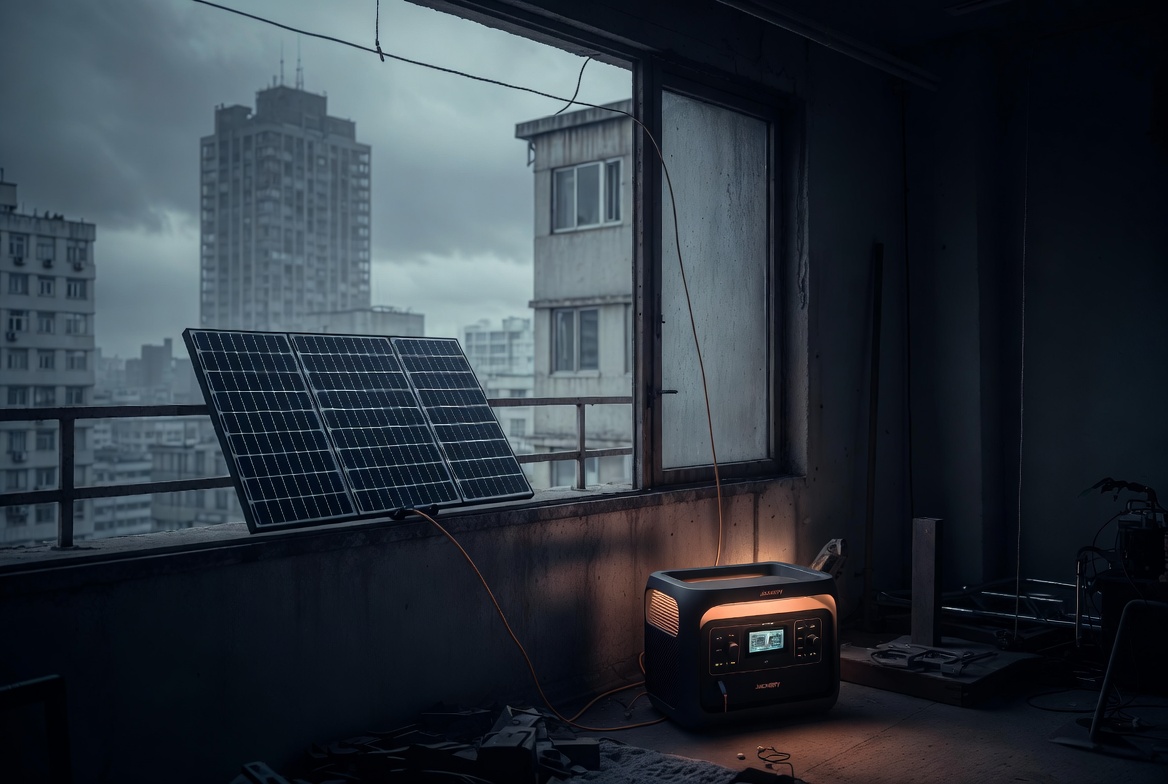

The Trap of Urban Energy Independence
In the urban survival community, a “Grid Down” scenario is the ultimate reality check. When discussing off-grid power generation, the first image that comes to mind is an isolated cabin in the woods with a roof covered in fixed solar arrays.
But what if you live on the 5th floor of a downtown apartment building?
The idea of using solar panels for apartments is often perceived as a myth by traditional preppers. Many claim it is impossible to generate enough power without a backyard or a south-facing roof. Others, poorly informed, simply stick a cheap panel behind a tinted double-pane window and are surprised when it produces nothing.
The reality is much more nuanced. Using solar panels for apartments is entirely possible, and it is ultimately the only viable long-term strategy. However, it requires strict discipline and specific hardware.
Behind the Glass: The Efficiency Drop
The beginner’s mistake is deploying a solar panel directly behind a closed window, hoping to get the manufacturer’s advertised wattage.
Modern glass is not designed to let all solar energy through. Double glazing, anti-UV treatments, and thermal films block a massive portion of the light spectrum that photovoltaic cells desperately need.
- The Physical Reality: A panel placed behind modern double glazing can lose between 30% and 60% of its efficiency. If the sunlight isn’t direct (e.g., cast shadows from neighboring buildings), production plummets to near zero.
- The Solution: You must break the barrier. The panel needs direct exposure to sunlight. This means hanging it over a balcony railing, mounting it on a wide windowsill, or opening the window wide during peak sunlight hours.

Urban Solar OpSec (Stealth)
Exposing your gear to direct sunlight immediately creates the opposite problem: visual vulnerability.
During a prolonged crisis, the baseline rule is stealth, the very concept of the Gray Man. If you hang large, highly reflective solar panels from your balcony while the entire neighborhood is plunged into darkness, you are broadcasting a beacon for miles. You instantly become the number one target for looters.
The Rules of Solar OpSec (Operational Security):
- Anti-Glare: Opt for foldable panels with an ETFE coating (which absorbs light rather than reflecting it like a mirror).
- The Blind Spot: Do not angle the panel directly toward the street. Use the blind spots of your balcony. It is better to lose 15% of solar yield than to attract 100% of the attention.
- Rapid Retreat: Your panels must never be fixed installations in a city. You must be able to deploy them in 30 seconds and bring them inside in 10 seconds if a threat approaches or if surveillance drones (like those of the Smart City) fly overhead.
The Incomplete Equation: Storage
The biggest secret about solar panels for apartments is that they are useless on their own. A panel only generates electricity while the sun is shining. However, an SHTF crisis does not pause at sunset.
If you want to run a refrigerator without electricity, operate emergency radios, or keep medical equipment alive, the equation requires a critical component: the storage buffer.
The energy you discreetly harvest during the day must be stored in a battery capable of absorbing heavy loads and dispensing power silently at night.
This is where the system comes together. As detailed in our review of survival solar generators, pairing high-efficiency foldable solar panels (like the SolarSaga) with a robust power station (such as the Jackery Explorer 1000 or higher) is the only reliable architecture. The panel stealthily captures the energy, the Jackery securely stores it (without the fire risk of older lithium, using LiFePO4), and you deploy that power when you need it most, even in pitch-black darkness.
In the Field: “The Dawn of Resilience”
In the novel The Dawn of Resilience, survival in the heart of a hostile megalopolis depends entirely on this asymmetric energy management.
The Zero Trust Village cannot afford to run noisy gas generators or build sprawling solar farms visible from the sky. The survivors deploy tactical, foldable panels on ruined windowsills only during off-peak hours, hoarding power into silent portable generators. This energy is then used at night to power the servers of the resistance’s Mesh network, securing their communications while remaining invisible to the militia’s thermal cameras.
Verdict: Feasible, but Tactical
Using solar panels for apartments is not a myth. It is a tactical reality. It simply requires abandoning the idea of powering a 60-inch plasma TV and focusing instead on the essentials: communications, refrigeration, and security.
Do not fall into the trap of placing a cheap gadget panel behind a closed window. Invest in a powerful foldable panel, master your visual OpSec, and store the energy in a reliable solar generator.
Ready to Build Your Sanctuary?
Energy independence is just one battle in the war for autonomy. To see how individuals organize to take back power from a collapsing system, and how these tactics are applied daily, dive into The Dawn of Resilience.
Discover how to survive when the system decides to turn you off.

The Future of Autonomous Solar
If you are looking for an even more advanced, self-deploying autonomous solution to complement this setup, read our thoughts on the Jackery Solar Mars Bot.