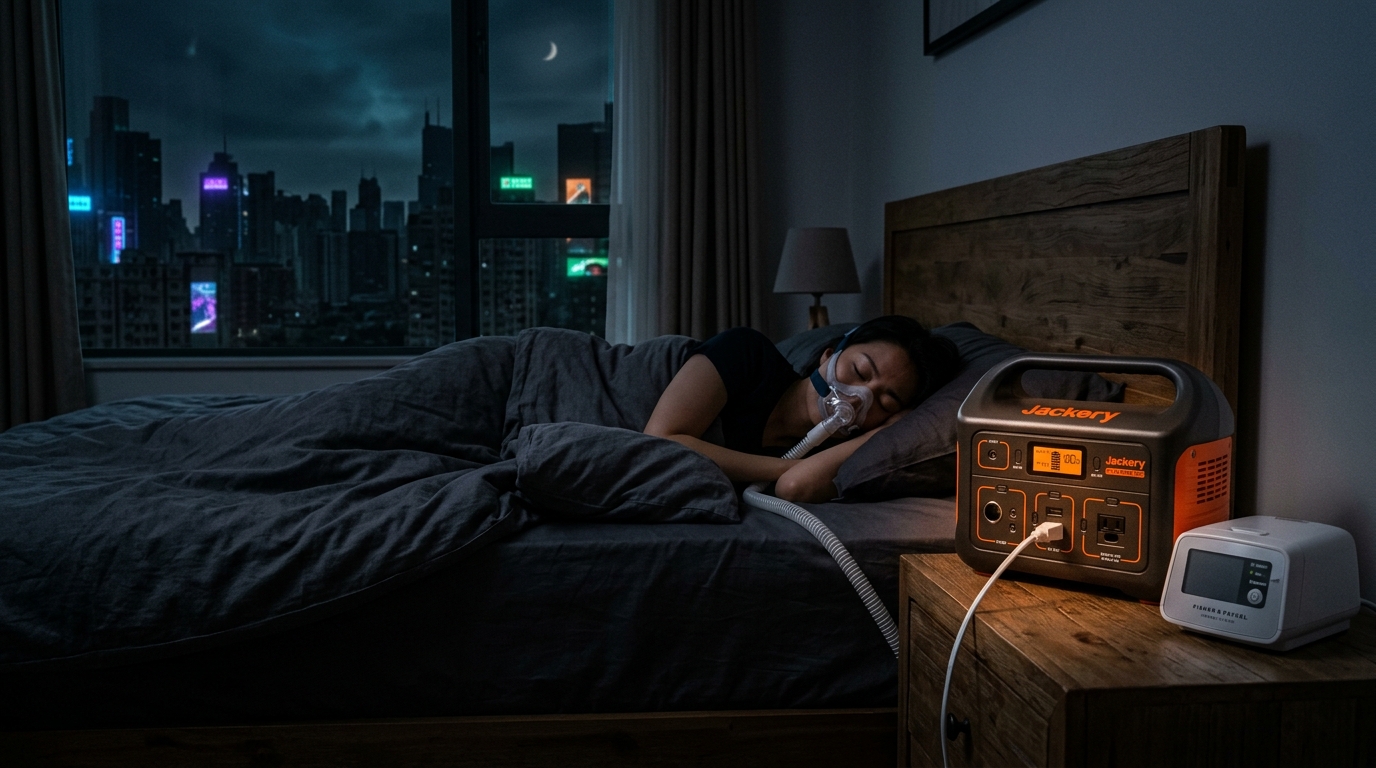
Imagine waking up gasping for air in the dead of night. The eerie silence of a grid failure fills your apartment. This moment underscores the risk of power outages for sleep apnea sufferers. For those who suffer from sleep apnea, a power outage isn’t just an inconvenience that spoils the food in the fridge or cuts off the Wi-Fi. It is a direct and immediate threat to your health. When the grid goes down, your CPAP (Continuous Positive Airway Pressure) machine shuts off instantly, leaving you vulnerable to oxygen deprivation, severe fatigue, and dangerous spikes in blood pressure.
The Hidden Dangers of Grid Reliance for Sleep Apnea Therapy
Millions of people rely on CPAP therapy to maintain open airways during sleep. Under normal circumstances, you plug your device into the wall and sleep soundly. But what happens during a sudden midnight blackout?
When the machine loses power, the continuous airflow stops. Depending on your mask type, you may suddenly find yourself breathing your own exhaled carbon dioxide, triggering a panic response. Beyond the immediate shock of waking up choking, the lack of CPAP therapy for even a single night can lead to:
- Severe daytime cognitive impairment.
- Elevated cardiovascular stress and high blood pressure.
- An inability to handle the physical and mental demands of an unfolding crisis.
Urban dwellers are uniquely vulnerable here. If you are preparing for apartment blackout survival, securing a backup power supply for medical devices must be at the very top of your priority list, ahead of lighting and entertainment.
Gas Generators vs. Solar Power Stations: The Indoor Safety Dilemma
When people think of emergency backup power, they often picture loud, rumbling gas generators. But if you live in a high-rise building or an apartment complex, a gas generator is a lethal liability.
Gas-powered generators emit carbon monoxide (CO), a colorless, odorless gas that can quickly build up indoors, leading to carbon monoxide poisoning and death. You cannot run a gas generator inside your home, on a closed balcony, or near an open window. Furthermore, in an urban crisis, fuel scarcity becomes an immediate issue, and the extreme noise of a combustion engine destroys your operational security (OPSEC), broadcasting to everyone in the building that you have power and resources.
This is why a portable solar power station is the only viable CPAP power outage backup for city living. Lithium-ion and LiFePO4 battery banks are:
- 100% Silent: They produce zero noise, ensuring your sleep isn’t disturbed by engine rumble.
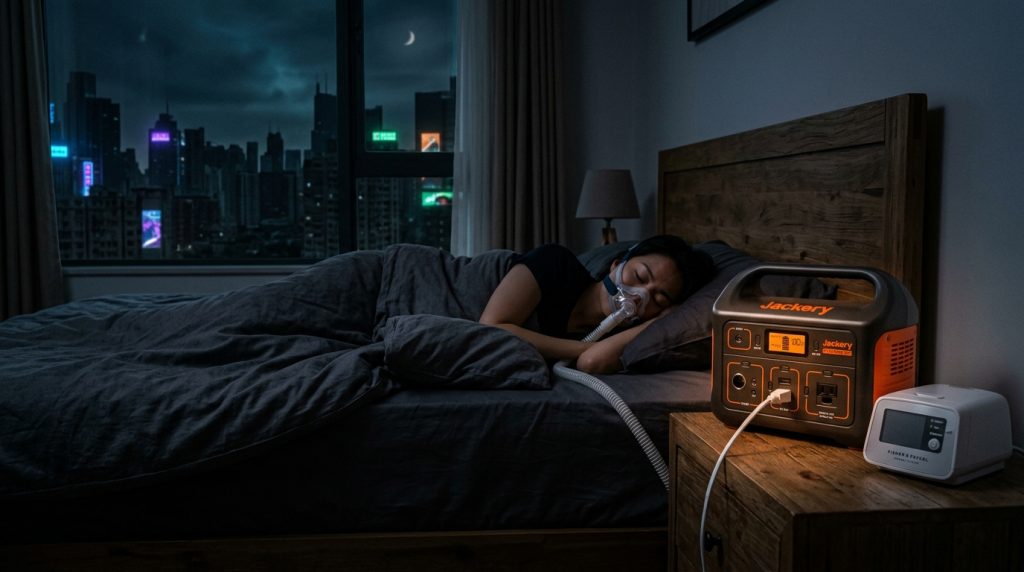
- Zero Emissions: They are completely safe to operate right next to your bed on a nightstand.
- Plug-and-Play: No pulling cords, checking oil, or storing highly flammable gasoline in your apartment.
If you’ve already built a stealth camper power system for your bug-out vehicle, you already know the unmatched superiority of portable power stations. The same logic applies directly to powering your critical medical devices at home.
Calculating Your CPAP Machine’s Power Requirements
Before purchasing a backup battery, you must understand how much power your specific CPAP machine draws. Not all CPAP machines are created equal, and the way you use your machine dramatically impacts its power consumption.
The Humidifier and Heated Tube Trap
Most modern CPAP machines come with a heated humidifier and a heated hose to make the air more comfortable. While great for everyday use, these heating elements are absolute battery killers.
- With Humidifier & Heated Hose ON: A CPAP machine can draw anywhere from 60 to 100 watts per hour.
- With Humidifier & Heated Hose OFF: The power draw drops drastically to just 10 to 15 watts per hour.
During a rolling blackout in the city, turning off the heated features is the single most important step you can take. By running your CPAP in “pressure only” mode, a mid-sized portable power station can easily power your machine for 3 to 4 nights on a single charge.
AC vs. DC Power Adapters
By default, you plug your CPAP into a standard AC wall outlet. If you plug that same AC cord into the AC outlet of a portable power station, the power station has to convert its internal DC battery power into AC power. This conversion process wastes about 15% to 20% of the battery’s capacity through heat loss.
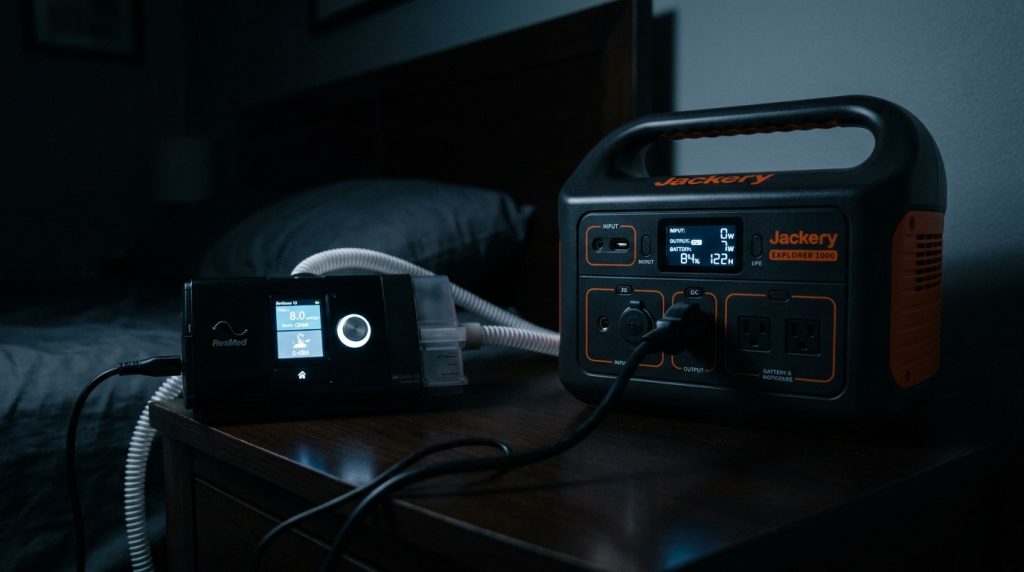
To maximize your CPAP power outage backup, purchase a 12V DC adapter specific to your CPAP brand (like ResMed or Philips). Plugging directly into the 12V cigarette lighter port or DC output of your solar generator bypasses the inverter, extending your battery life significantly.
Step-by-Step: Setting Up Your Off-Grid Sleep Station
Building your resilient medical power setup is simple if you follow these steps:
- Test Your Equipment: Do not wait for a storm to hit. Purchase your portable power station and DC adapter today. Unplug your CPAP from the wall and run it off the battery for a full night to see exactly how much percentage is drained.
- Turn Off Climate Control: Dive into your CPAP’s clinical settings or user menu and disable the heated tube and humidifier. Record the difference in power draw.
- Establish a Charging Routine: Keep your power station topped up. You can charge it via a wall outlet when the grid is up, or use portable solar panels on your apartment balcony to recharge during an extended grid-down scenario.
- Positioning: Keep the power station right next to your bed. Many modern units have pass-through charging (working as an Uninterruptible Power Supply or EPS), meaning you can leave the CPAP plugged into the battery, and the battery plugged into the wall. If the grid drops, the battery takes over in milliseconds, and you won’t even wake up.
⚡ Equip Yourself: The Ultimate CPAP Power Source
When your ability to breathe through the night depends on a battery, you cannot afford to rely on cheap, untested off-brand electronics. You need a medical-grade, heavily tested, and ultra-reliable power core.
After extensive testing in urban survival scenarios, we have identified the absolute best portable solar generators to serve as your dedicated CPAP power outage backup. From battery longevity to silent operation, these units are the backbone of a resilient apartment.
👉 Read our full breakdown and secure your power supply here:
Jackery Review: The Essential Power Station for Urban Survival
Frequently Asked Questions (FAQ)
Can I run my CPAP on a solar generator?
Absolutely. A portable solar generator (power station) is the safest and most efficient way to run a CPAP machine during an outage, especially indoors where gas generators are prohibited.
How long will a power station run my CPAP machine?
It depends on the battery capacity (measured in Watt-hours) and your machine’s settings. A 500Wh power station can run a CPAP for 1-2 nights with the humidifier on, or up to 5-7 nights if the humidifier and heated hose are completely turned off.
Should I use the AC plug or a DC adapter for my CPAP?
Always use a DC adapter if possible. Bypassing the AC inverter on your power station saves around 15-20% of your battery life, giving you significantly more runtime during a long blackout.
Is it safe to keep a lithium power station in my bedroom?
Yes. Modern power stations from reputable brands use advanced Battery Management Systems (BMS) to prevent overheating and overcharging. LiFePO4 (Lithium Iron Phosphate) batteries are particularly known for their extreme thermal stability and safety.
Will my insurance or Medicare pay for a CPAP backup battery?
In most cases, health insurance and Medicare do not cover backup batteries for CPAP machines, classifying them as “convenience items.” You will likely need to purchase your CPAP power outage backup out of pocket, making multi-purpose power stations a much better investment than single-use CPAP batteries.
Securing Your Health During Extended Grid Failures
Securing a CPAP power outage backup is just the first step in protecting your health during a crisis. As the grid becomes more fragile, our reliance on technology for survival becomes our greatest vulnerability. From keeping your medications refrigerated to ensuring your communication lines stay open, true urban resilience requires a comprehensive, zero-trust approach to infrastructure.
Do not wait for the lights to go out and the machines to stop humming before you take action. The time to build your personal grid is now. Just like Ethan and Aura in Roman Deville’s dystopian universe, those who survive the collapse are the ones who prepared while the lights were still on. Don’t be caught gasping in the dark.
📖 Ready to master the art of urban survival and digital sovereignty?
Download Chapter 1: The Dawn of Resilience completely free and start building your indestructible off-grid plan today.