When the power grid collapses, silence is the first casualty. Within hours of a catastrophic event—whether a targeted cyberattack, an EMP strike, or a simple regional blackout—cell towers will drain their backup batteries and die. The internet will fracture. Your smartphone, built for constant connection to centralized servers, will become a useless brick of glass and lithium.
In an emergency, isolation breeds panic. To survive the initial chaos and organize with your community or family, you must establish an off-grid communication** infrastructure.
You can no longer rely on the corporate network. Here is the operational blueprint for building a decentralized mesh network and securing your communications when the grid goes dark.
The Fragility of the Cellular Grid
The illusion of connectivity is maintained by thousands of vulnerable choke points. Modern cell towers rely on fiber-optic backbones and constant municipal electricity. During a crisis, even if the towers remain powered, the network instantly suffers from “congestion collapse” as millions of panicked citizens attempt to call their loved ones simultaneously.
Furthermore, as we established in our analysis of smart city surveillance, maintaining a connection to a traditional cellular grid means broadcasting your exact coordinates to the state or whichever malicious actor controls the tower arrays.
To achieve true digital sovereignty and physical safety, you must cut the cord. You must build a network that you own.
What is a Mesh Network?
A mesh network is the ultimate expression of the “Zero Trust” philosophy applied to communications. Instead of relying on a centralized hub (like a cell tower or a Wi-Fi router) to pass messages between users, a mesh network allows devices to talk directly to one another.
Every device (or “node”) in the network acts as a relay. If you send a message to a contact five miles away, your device broadcasts the encrypted packet to the nearest node, which bounces it to the next, until it reaches its destination. There is no central server to hack, track, or shut down. If one node fails, the network simply reroutes the message through the others.
It is a resilient, self-healing, and virtually unstoppable communication protocol.
Tier 1: Local Tactical Comms (The GoTenna Protocol)
For short-range, encrypted communication between family members or a survival group navigating an urban environment, you need lightweight, low-power nodes.
The industry standard for civilian mesh networking is the GoTenna Mesh or similar LoRaWAN (Long Range Wide Area Network) devices. These small, weather-proof antennas pair with your smartphone via Bluetooth. When your phone is in “Airplane Mode” (or better yet, when you are using a degoogled phone), the GoTenna broadcasts your text messages and GPS coordinates over VHF/UHF radio frequencies to other users in your group.
👉👉👉 Deploy your tactical comms with a GoTenna Mesh Network Device
By deploying these devices, your group can coordinate movements, share danger zones, and maintain absolute silence on the traditional radio spectrum. It is tactical OPSEC in your pocket.
Tier 2: The Global Lifeline (Satellite Communication)

A local mesh network is vital for immediate survival, but what if the disaster is regional or national? What if you need to coordinate an evacuation route, contact emergency services outside the blackout zone, or access critical off-grid financial assets like your post-quantum crypto vault ?
Radio waves have physical limits. When you need a global lifeline, you must bypass the earth’s infrastructure entirely and point your signal at the sky. You need a satellite phone.
Unlike traditional cell phones, satellite communication devices link directly to orbital constellations (like Iridium or Inmarsat), making them immune to ground-level disasters, EMPs (if stored properly in a Faraday bag), and local censorship.
We do not recommend generic hardware for this level of security. For military-grade satellite comms and data terminals, we rely on the industry leaders at Satellite Phone Store.
👉👉👉 Establish your global lifeline with encrypted Satellite Comms
Whether you need a ruggedized Iridium handset for extreme environments or a Bivy Stick for two-way satellite messaging from your smartphone, securing a satellite uplink is the final layer of your off-grid architecture.
The Dawn of Digital Rebellion
Relying on the state to connect you is a luxury of the old world. In a shifting landscape of digital authoritarianism and fragile infrastructure, the ability to communicate securely and independently is not just a survival skill; it is an act of rebellion.
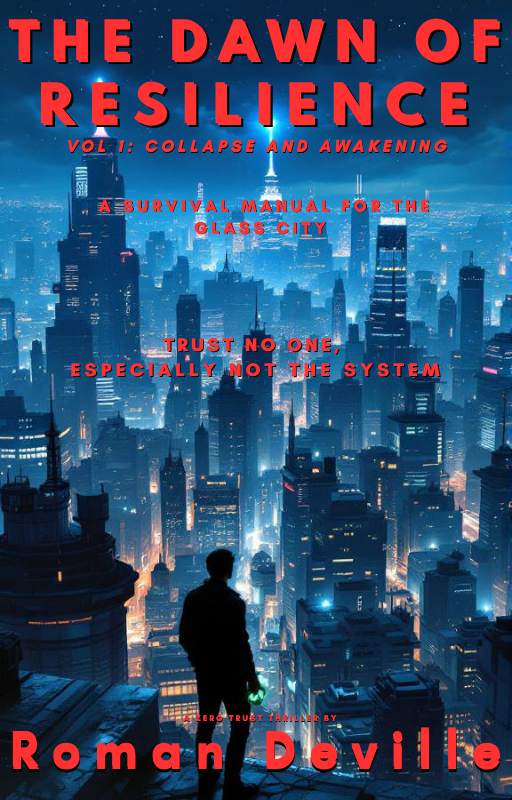
In my cyberpunk thriller, The Dawn of Resilience, Ethan and Aura survive the manhunt in the fallen city of New-Babel not with superior firepower, but with superior communication. By utilizing decentralized mesh networks and encrypted radio frequencies, they move like ghosts through a city designed to track their every footstep.
The corporate grid is a single point of failure. Are you ready to build your own network?