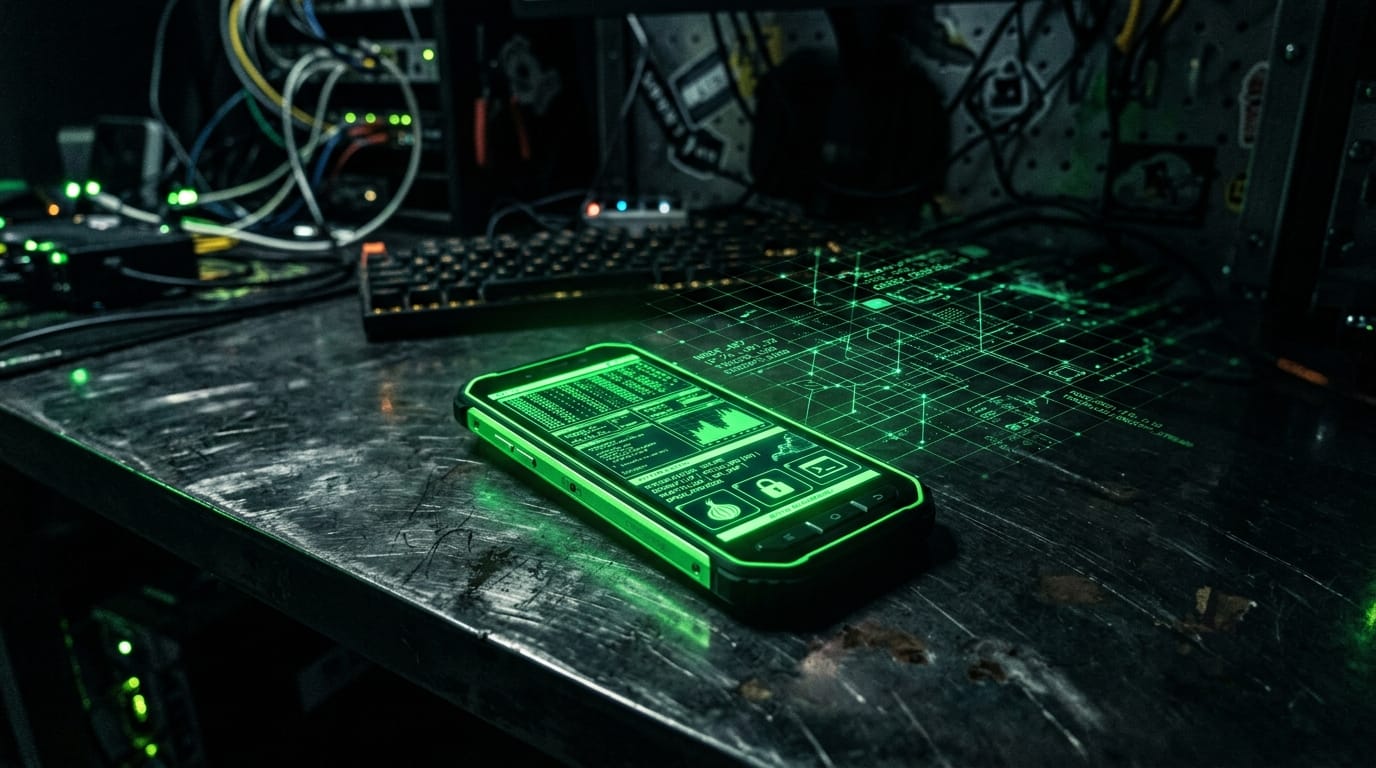
If you carry a modern smartphone, you are carrying a tracking device that you paid for yourself. The convenience of GPS, cloud synchronization, and app ecosystems comes at the ultimate price: absolute loss of operational security.
In a functioning society, this is a privacy nightmare. In a grid-down scenario or a shift toward digital authoritarianism, it is a lethal vulnerability. Your phone broadcasts your location, your habits, and your associates to servers controlled by the state and massive tech monopolies.
If you want to survive the algorithmic panopticon (a control system proving that 1984 was not an instruction manual, but a reality), you must reclaim your communication hardware. Here is why the modern “burner” is a degoogled phone, and how to secure your digital perimeter.
The Spy in Your Pocket: How Big Tech Tracks You
Apple’s iOS and Google’s Android (which powers over 70% of the world’s smartphones) are not just operating systems; they are data-harvesting ecosystems.
Even if you turn off “Location Services” and use a zero trust vpn, a standard Android phone is hardcoded with Google Play Services. These services run at the root level of the phone, constantly pinging cell towers, local Wi-Fi networks, and Bluetooth beacons.
They collect “telemetry data.” This means that even without a SIM card, if your phone connects to a public Wi-Fi node for a fraction of a second, your device’s unique MAC address is logged. When corporate data brokers or Palantir surveillance networks aggregate this data, they can map exactly where you sleep, where you work, and who you meet.
In an emergency evacuation, a standard smartphone makes the “Gray Man” theory impossible to execute. You cannot hide if you are transmitting a beacon.
What is a Degoogled Phone?
To stop the bleeding of your data, you must amputate the source. A degoogled phone is a standard smartphone (usually a specific model of Google Pixel) where the entire stock operating system has been wiped and replaced with a custom, privacy-focused open-source ROM.
The most secure and respected of these operating systems is GrapheneOS.
The GrapheneOS Architecture
GrapheneOS strips out every piece of Google code. There is no Google Play Store, no hidden tracking services, and no background telemetry pinging Silicon Valley servers.
Instead, it is a hardened version of the Android Open Source Project (AOSP). It offers extreme security features:
- Sandboxed Apps: If you absolutely must use a mainstream app, GrapheneOS forces it into an isolated “sandbox,” preventing it from accessing your contacts, microphone, or real location.,
- Network Obfuscation: It randomizes your MAC address on every connection, making it impossible to track your physical movement across different Wi-Fi networks.,
- Rapid Auto-Reboot: You can configure the phone to automatically reboot after a set time, locking the encryption keys and making data extraction nearly impossible if the device is seized.,
A degoogled phone running GrapheneOS is the closest you can get to a digital ghost.
Physical OPSEC: The Hardware Perimeter

While a degoogled phone protects you from software surveillance, you must still manage the hardware’s physical emissions. Even the most secure operating system must connect to a cell tower to make a call, and that connection can be intercepted by IMSI catchers (Stingrays).
When you are moving through a hostile urban environment or bugging out, you cannot risk an accidental transmission.
This is where your urban bug out bag must interface with your digital security. When your phone is not in active use, it must be completely silenced. Powering it down is not enough; modern basebands can sometimes be triggered remotely even when the OS is off.
You must use a Faraday Bag.
👉 Equip your EDC with a military-grade Faraday Phone Sleeve
Slipping your degoogled phone into a Faraday bag instantly severs all RF, GPS, Wi-Fi, and cellular connections. It is the ultimate physical kill switch for your digital life.
Encrypted Communications: Beyond the Cell Tower
Securing the device is the first step. Securing the transmission is the second. If the local cellular grid collapses, your degoogled phone needs a decentralized way to communicate.
For short-range, off-grid communication, survivalists are increasingly relying on localized “mesh networks.” By pairing your secure phone via Bluetooth to a portable mesh radio, you can send encrypted text messages and GPS coordinates to your team without relying on cell towers or internet infrastructure.
👉 Deploy off-grid comms with a GoTenna Mesh Network Device
These devices create a peer-to-peer (P2P) network. It is the communication equivalent of holding your wealth in privacy coins ; it is decentralized, unstoppable, and outside the control of the state.
Protecting Your Burner: A degoogled phone is your first line of defense, but it still emits an RF signature. To ensure absolute operational security when moving through hostile environments, your burner must be shielded. Discover the tactical gear required in our guide to The Arsenal: Physical OPSEC and Faraday Defense Systems.
The Dawn of Digital Rebellion
You do not own a device if you do not control its code. In a world hurtling toward algorithmic control, reclaiming your communication hardware is an act of rebellion.
This philosophy is the survival mechanism for Ethan and Aura in my cyberpunk thriller, The Dawn of Resilience. Hunted by a smart city that tracks every digital heartbeat, they survive by shedding their consumer tech and relying on hardened, degoogled devices and mesh networks to organize their escape.
Your smartphone is a liability. Are you ready to upgrade to an asset?