We have traded our privacy for the illusion of safety. Modern urban centers are no longer just concrete and steel; they are massive data-harvesting machines. From automated traffic enforcement to AI-driven security cameras on every street corner, smart city surveillance** has created an inescapable digital panopticon.
But what happens when the grid stutters? What happens when a localized emergency, a cyberattack, or a systemic failure disrupts the algorithms?
The terrifying truth is that a smart city does not fail gracefully. When the network fractures, the surveillance infrastructure meant to protect the population often becomes its greatest threat. Here is the operational reality of a smart city collapse, and how to evade facial recognition during a crisis.
The Architecture of smart city surveillance
To understand the threat, you must understand the network. A modern smart city relies on an interconnected web of sensors. Closed-circuit television (CCTV) cameras are no longer just recording video; they are actively processing it.
Through advanced machine learning and facial recognition software, these cameras cross-reference your biometrics against state databases, social media profiles, and even your Worldcoin iris scan data.
In a functioning city, this means the state knows when you leave for work, who you meet, and what protests you attend. It is the physical manifestation of the Palantir surveillance grid. But the inherent danger of this system is its extreme reliance on continuous cloud computing and uninterrupted electricity.
When the Grid Stutters: The “Fail-Secure” Trap

In cybersecurity, systems are designed to either “fail-safe” (opening up to prevent harm) or “fail-secure” (locking down to protect data and assets). Because smart city surveillance is managed by corporate and state security apparatuses, the infrastructure is heavily biased toward “fail-secure.”
If a severe blackout (or an EMP event) disrupts the primary grid, backup generators kick in. But they do not prioritize traffic lights or civilian communication; they prioritize data centers and security perimeters.
During a localized crisis—such as a riot, a terror attack, or a sudden quarantine mandate—the algorithms can be weaponized.
- Algorithmic Profiling: If panic erupts on the streets, AI cameras programmed to detect “anomalous behavior” (like running or covering your face) will automatically flag you as a threat to law enforcement, regardless of your actual intentions.
- Automated Geofencing: Digital turnstiles in subways, electronic toll booths, and smart-locked public buildings can instantly trap populations in designated zones to “contain” a crisis.
- False Positives: When servers are strained or bandwidth drops during a mass emergency, the error rate of facial recognition skyrockets. You could be misidentified as a hostile actor simply because the algorithm lacks the processing power to distinguish faces in a chaotic, poorly lit environment.,
In a smart city collapse, you are not a citizen trying to survive; to the failing algorithm, you are just an unpredictable data point that needs to be contained.
Evading the Panopticon: The “Gray Man” Doctrine
If you find yourself trapped in a smart city during an escalating crisis, your primary objective is not to fight the system, but to become invisible to it. You must adopt the “Gray Man” theory.
Being a Gray Man means blending into the baseline of your environment. It means offering no actionable data to either human predators or AI cameras.
1. Defeating Facial Recognition (Biometric Obfuscation)
Facial recognition algorithms rely on mapping the geometry of your face—specifically the distance between your eyes, the depth of your eye sockets, and the shape of your jawline. Disrupting just one of these metrics drastically reduces the AI’s confidence score.
- The Baseline Defense: Wearing a standard, low-profile baseball cap pulled low over the brow obscures the eyes from overhead CCTV cameras. When combined with dark, polarized sunglasses (which block infrared eye-tracking), you effectively blind the algorithm.,
- Medical Masks: In a post-2020 world, wearing a surgical mask or an N95 respirator does not draw human suspicion, but it successfully hides the lower half of your facial geometry from the machine.,
👉Equip your urban survival kit with Polarized Tactical Sunglasses
2. Digital Silence,
As we discussed in our Ultimate Urban Bug Out Bag guide, physical evasion is useless if your pocket is broadcasting a beacon. Your smartphone constantly pings local Wi-Fi networks and Bluetooth receivers (which are embedded in smart city streetlights and billboards) to determine your location.
During an emergency evacuation, you must place your mobile devices in a Faraday bag. You cannot afford to let your MAC address betray your escape route.
👉 Read our full breakdown in THE ARSENAL: Building a Post-Quantum Crypto Vault with Faraday Protection
The Ultimate Defense: Turning off your phone in a smart city isn’t enough to stop tracking. You need a physical barrier. To understand how to completely cloak your electronic devices from surveillance grids and EMP attacks, read our full breakdown on Physical OPSEC and Faraday Defense Systems.
The Dawn of Digital Rebellion
The promise of the smart city was absolute convenience. The reality is absolute vulnerability. As urban centers become increasingly automated, the ability to operate “off-grid” within city limits becomes a mandatory survival skill.
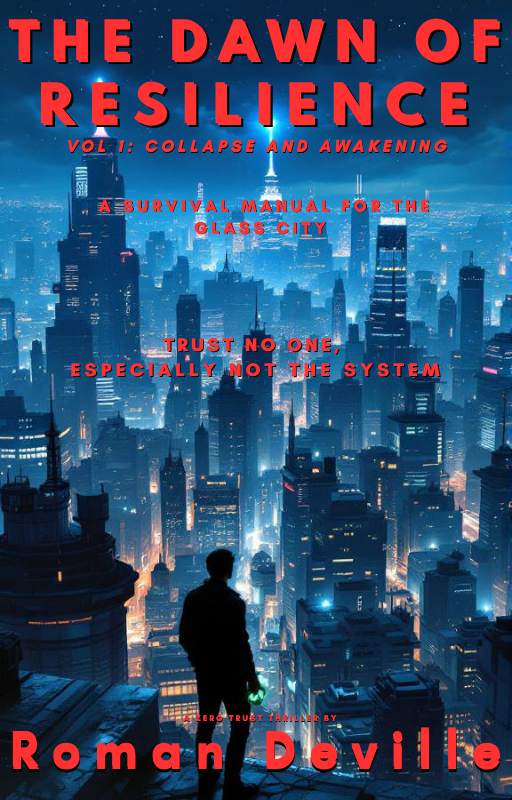
This clash between algorithmic control and human evasion is the central conflict in my cyberpunk thriller, The Dawn of Resilience. As the city of New-Babel descends into martial law, Ethan and Aura must use every Gray Man tactic in the book to navigate a landscape where the cameras are always watching, and the code is always judging.
The grid is watching. Are you ready to disappear?