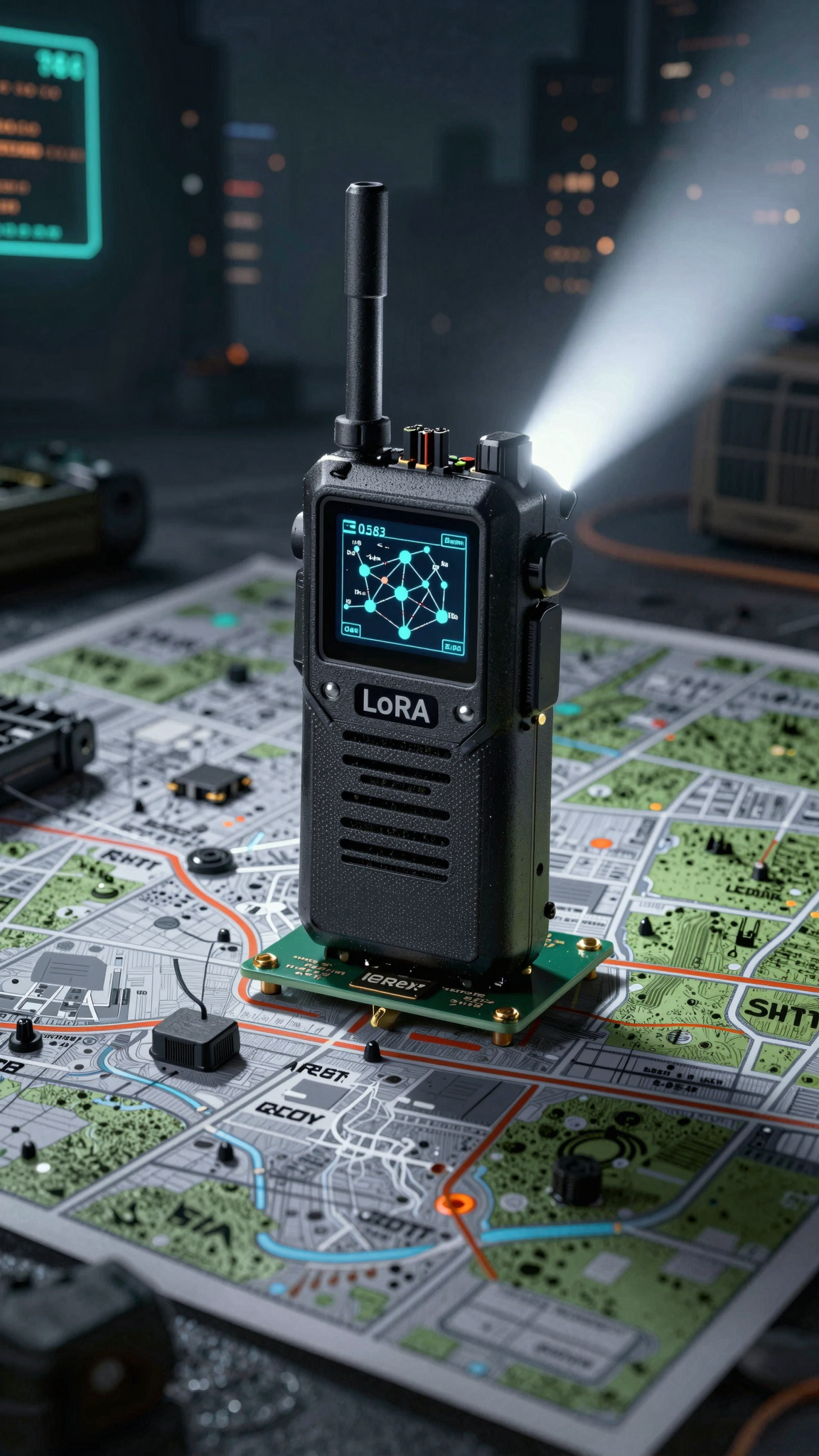
If your survival or resilience plan relies on making a standard phone call or sending a text via 4G/5G, you don’t actually have a survival plan. In an increasingly unstable world, dependence on centralized telecommunication infrastructure is your greatest vulnerability. To prepare for severe grid down scenarios, you must build your own autonomous network. This is where Meshtastic, paired with the LoRa protocol, becomes a mandatory asset.
The Fragility of Centralized Cell Networks
The illusion of permanent mobile internet hangs by a thread. The first critical failure point is electrical dependency. Without power, cell towers fail within hours, as their backup batteries are designed for micro-outages, not genuine, prolonged blackouts.

Secondly, congestion and state control present massive threats. During a natural disaster, a panic event, or a major crisis, cellular networks become saturated in minutes. Worse, in scenarios involving martial law or authoritarian overreach, these centralized networks can be intentionally throttled, censored, or monitored end-to-end. If you are serious about your digital sovereignty, you need an alternative that doesn’t rely on ISPs.
Understanding LoRa and the Meshtastic Ecosystem
The countermeasure to centralization is technological decentralization.
LoRa (Long Range) is a low-power, wide-area radio modulation technology. It allows the transmission of small data packets over impressive distances—ranging from a few miles in dense urban environments to tens of miles in open areas—without requiring a SIM card, a subscription, or any internet infrastructure.
Meshtastic is the open-source firmware that brings LoRa hardware to life. It transforms small, inexpensive radio transceivers into tactical communication nodes.
The true power lies in the Mesh network topology. Unlike cellular networks where everyone connects to a central tower, a mesh network is fully decentralized. Every Meshtastic node receives messages and rebroadcasts them to others. The result? The more users join the network, the stronger, wider, and more resilient it becomes. Without a central server, there is no single point of failure.
Architecting Your Tactical Radio Node
Acquiring the necessary hardware is accessible, robust, and highly cost-effective for civilian operators.
The ideal base module—such as a LILYGO T-Echo or a Rak Wireless kit—integrates a battery, an antenna, and often a low-power e-ink display. The tactical approach involves pairing this radio node with your hardened GrapheneOS smartphone via Bluetooth. You type an encrypted message from the Meshtastic app on your de-googled phone, and the radio pushes it out over the airwaves.
For your local infrastructure (your autonomous base), the best practice is to deploy a “Relay” node. This node should be weatherproof, mounted as high as possible on a roof, and passively powered by a Jackery Solar Generator setup or smaller dedicated solar panels. This relay will flood your urban or suburban area with signal coverage, keeping your team connected.
Radio OpSec and Cryptographic Limitations
Deploying your own radio infrastructure demands strict operational hygiene (OpSec).
Encryption Standards: Meshtastic natively utilizes military-grade AES-256 encryption. Anyone with a compatible antenna can intercept your radio waves, but without the specific cryptographic key shared among your private channel, they will only intercept unreadable digital noise.
The Triangulation Threat: Any radio transmission theoretically makes you trackable via signal direction finding (goniometry) by a well-equipped adversary. To mitigate this risk, never carry an actively transmitting node on your person continuously. Rely on fixed relay nodes to obfuscate your actual physical location.
Tactical Limitations: It is crucial to understand that this is a “low bandwidth” network. It is absolutely perfect for transmitting critical GPS coordinates or short tactical text messages. Do not expect to send voice notes or photographs. It is the very essence of operational minimalism.
If you are building an electronics cache, remember that radio nodes are highly susceptible to EMPs (Electromagnetic Pulses). Keep your backup Meshtastic modules safely stored inside SLNT Faraday Bags to ensure they survive a catastrophic grid event.
Frequently Asked Questions (FAQ)
What is the real-world range of a Meshtastic node?
In a dense city with concrete buildings, expect 1 to 3 miles. With clear line-of-sight (e.g., from a mountain top to a valley), ranges exceeding 50 miles have been successfully recorded. Height and antenna quality are the determining factors.
Do I need a ham radio license to use LoRa?
No. LoRa operates on the ISM (Industrial, Scientific, and Medical) bands (e.g., 915 MHz in the US, 868 MHz in Europe), which are license-free for public use as long as your equipment respects power transmission limits.
Can Meshtastic connect to the internet?
It doesn’t need to, but it can. If one node in the mesh is connected to Wi-Fi (acting as an MQTT gateway), it can bridge your local off-grid mesh to the global internet, though this breaks absolute off-grid isolation.
Securing Your Local Infrastructure
Communication autonomy is the central pillar of any team or family wishing to remain coordinated in a hostile environment. Purchasing and configuring your radio network before a crisis costs only a few dollars and a few hours of learning. During an actual crisis, this foresight is priceless.
In a true collapse scenario, relying on the state or corporations for your communications will leave you blind and mute. When the blackout strikes and state surveillance monitors the streets, it is through the ingenious use of ghost mesh networks that Aura and Ethan manage to maintain their off-radar communications. Discover how this survival theory applies under extreme conditions in The Dawn of Resilience, the first volume of the Zero Trust Chronicles trilogy.