
An Electromagnetic Pulse (EMP) is the ultimate nightmare scenario for the modern world.
Whether triggered by a high-altitude nuclear detonation or a massive Coronal Mass Ejection (CME) from the sun, an EMP has the potential to instantly fry microprocessors and wipe out the electrical grid.
For the urban prepper, an EMP presents a terrifying reality: your modern bug-out vehicle, packed with electronic control modules, might become a two-ton brick in your driveway.
More alarmingly, the backup gear you rely on to survive the aftermath could also be destroyed.
If you want to guarantee your escape and your off-grid survival, you must build an EMP resistant power supply cache. We are going to detail exactly how to harden your most critical asset—your solar generator—against the ultimate invisible threat.
The Vulnerability of Modern Survival Tech
The irony of modern survival gear is that it relies on the very technology an EMP destroys.
A high-quality LiFePO4 portable power station is a lifesaver during a standard blackout. However, inside that rugged plastic casing is a complex Battery Management System (BMS), a digital display, and a microchip-controlled Pure Sine Wave inverter.
If those microchips are exposed to a severe electromagnetic pulse, the circuitry will fuse. The massive battery inside will be perfectly fine, but you will have absolutely no way to access or regulate its power.
To maintain an EMP resistant power supply, the generator itself must be shielded from the environment.
Building the Vehicle Faraday Cache
The only proven method to protect electronics from an EMP is to enclose them in a Faraday cage—a continuous conductive shield that intercepts and redistributes electromagnetic radiation.
In a bug-out vehicle scenario, space and weight are critical, so you cannot use bulky metal trash cans.
Military-Grade Faraday Bags
The most effective solution for an urban vehicle cache is a heavy-duty, military-grade Faraday bag.
These bags are constructed with multiple layers of highly conductive fabrics, usually incorporating silver and copper mesh.
When you place your portable solar generator inside the bag and seal it tightly (rolling the top and securing it as instructed), you create an isolated environment. The EMP wave hits the conductive exterior of the bag and travels around it, leaving the sensitive BMS inside the generator completely untouched.

[Insert Image 2 here]
The Nested Shielding Strategy
For absolute certainty, advanced preppers use a nested shielding strategy.
You place your solar generator inside a primary Faraday bag. Then, you place your folded solar panels, your tactical radios, and backup hard drives in their own smaller Faraday sleeves.
Finally, all of these shielded items are stored inside an aluminum or steel vehicle lockbox in the trunk.
This multi-layered approach ensures that even if one layer is compromised or improperly sealed, the nested layers will absorb the residual pulse. This guarantees your EMP resistant power supply will function when you finally unseal it in the dark.
Post-Pulse Deployment
If the worst happens, the world will be silent.
Modern cars will stall on the highway. Cell phones will be dead glass. The grid will be gone for months, if not years.
But when you open your trunk and unseal your Faraday cache, you will have a fully functional, pristine power core.
You can pull out your solar panels, power up your radios, and initiate your evacuation protocols while the rest of the city is paralyzed. You will have preserved the fire of modern technology.
Don’t let an invisible pulse destroy your survival strategy. Shield your generator and secure your future.
Read our full Jackery Review: The Essential Power Station for Urban Survival
FAQ: EMP Resistant Power Supply
Will an EMP destroy a portable solar generator?
Yes. While the battery cells might survive, the microchips controlling the Battery Management System (BMS) and the inverter are highly vulnerable to an EMP. You must store the unit in a Faraday shield.
How do I build an EMP resistant power supply cache?
Store your portable power station and foldable solar panels inside certified, multi-layer Faraday bags. Keep these sealed bags inside a secure compartment in your bug-out vehicle until needed.
Do solar panels need EMP protection?
The raw photovoltaic cells are generally resistant to EMPs. However, the diodes and the small charge controllers often built into foldable panels are vulnerable. It is highly recommended to store them in Faraday bags as well.
The grid is fragile, and the line between fiction and reality is blurring rapidly. Hardware is only the first step. If you want to understand how quickly the system collapses and what it takes to survive when you are forced to evacuate, you need to look at scenarios that are unfolding right now. That is exactly why I wrote The Dawn of Resilience…
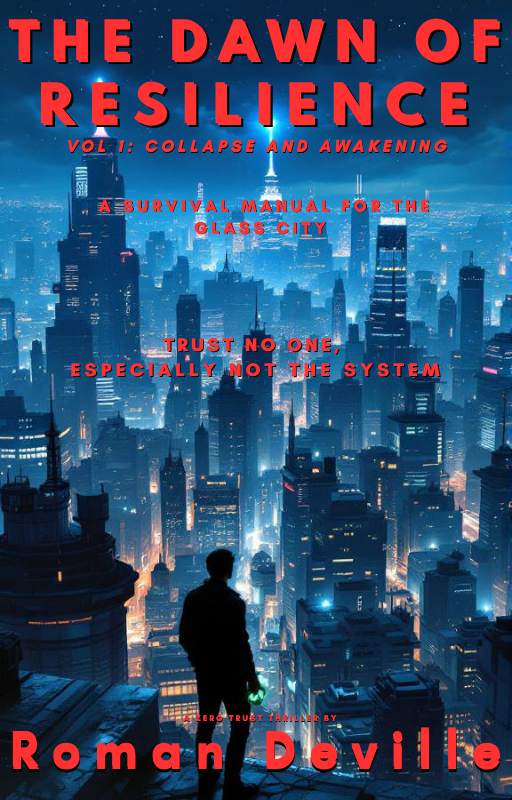
Download Chapter 1 of The Dawn of Resilience for FREE and start your journey.