When the terrestrial grid fails, the sky is your only remaining vector for communication. But as the corporate technostructure tightens its grip, simply bouncing a signal off a satellite is no longer enough to guarantee your sovereignty. This is why it must be integrated with a local Mesh Network.
The Illusion of Satellite Privacy
A lot of people think buying a Starlink dish makes them untrackable and invincible. This is a fatal miscalculation. Starlink is a phenomenal feat of engineering for bypassing local censorship, but it is not a privacy tool. With their recent policy updates openly siphoning subscriber data to train corporate AI models, Starlink has proven it is just another tentacle of the surveillance state.
If you are serious about off-grid OpSec, you don’t want a permanent, power-hungry dish broadcasting your location to Elon Musk’s servers. You need something mobile, rugged, and decentralized. You need the ability to vanish into the noise.
This is why the Iridium GO! remains the apex predator of zero-trust communication. Just as we discussed the necessity of blocking cell phone tracking in an urban environment, securing your global communications requires cutting the corporate cord.
Why the Iridium GO! is the Apex Predator of Comms
The Iridium network is fundamentally different from commercial internet satellite constellations. It relies on 66 cross-linked Low Earth Orbit (LEO) satellites that provide truly global coverage—from the middle of the Pacific Ocean to the polar ice caps.
- Global Mesh Network: Unlike geostationary satellites that require a clear line of sight to the equator, Iridium satellites pass data between themselves in space. You don’t need local ground infrastructure to make a connection.
- Low Power Signature: A Starlink dish requires significant wattage, meaning you are tied to a hefty solar generator. The Iridium GO! fits in your pocket, runs on an internal battery, and can be charged with a small, foldable solar panel.
- Decentralized Wi-Fi Bubble: It creates a localized, 100-foot Wi-Fi radius. You can keep your primary smartphone inside an EMP-proof Faraday bag, pull it out only when needed, connect to the Iridium GO! via Wi-Fi, send an encrypted message, and go dark again in seconds.
The Zero-Trust Communication Protocol
Having the hardware is only step one. How you use it dictates your survival. Here is the protocol I use for true off-grid sovereignty:
First, never use the default unencrypted SMS. When I deploy the Iridium GO!, my phone remains in airplane mode with cellular modems disabled. I connect exclusively via Wi-Fi to the device.
Second, I route all text communications through an end-to-end encrypted messaging application that supports low-bandwidth transmission. I am not browsing the web; I am sending compressed, encrypted text bursts containing GPS coordinates and critical intel to my designated trusted contacts.
Once the burst transmission is confirmed, the antenna is stowed, the device is powered down, and everything goes back into the Faraday cage. You become a digital ghost.
Drawing the Line in the Sky
Do not wait for the cell towers to go dark to realize your smartphone is a brick. In a true SHTF scenario, information is more valuable than ammunition. The ability to coordinate, receive weather updates, and communicate securely across the globe without relying on terrestrial ISPs or data-hungry mega-corporations is the ultimate tactical advantage.
The Iridium GO! isn’t cheap, and the subscription plans are designed for maritime and expedition use. But sovereignty has a price. How much is your digital freedom worth?

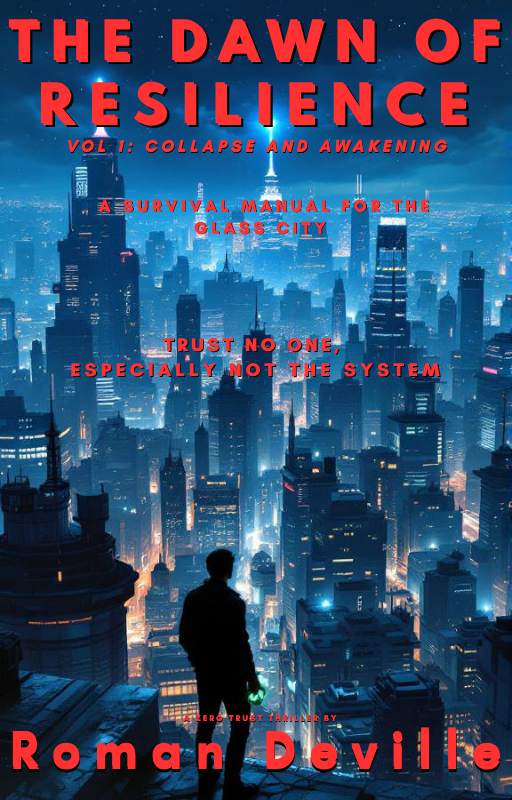
Want to see how these exact communication protocols hold up when the grid collapses? The fight for digital sovereignty isn’t just theoretical. Discover The Dawn of Resilience by Roman Deville—a cypherpunk SHTF thriller that doubles as an off-grid survival blueprint.