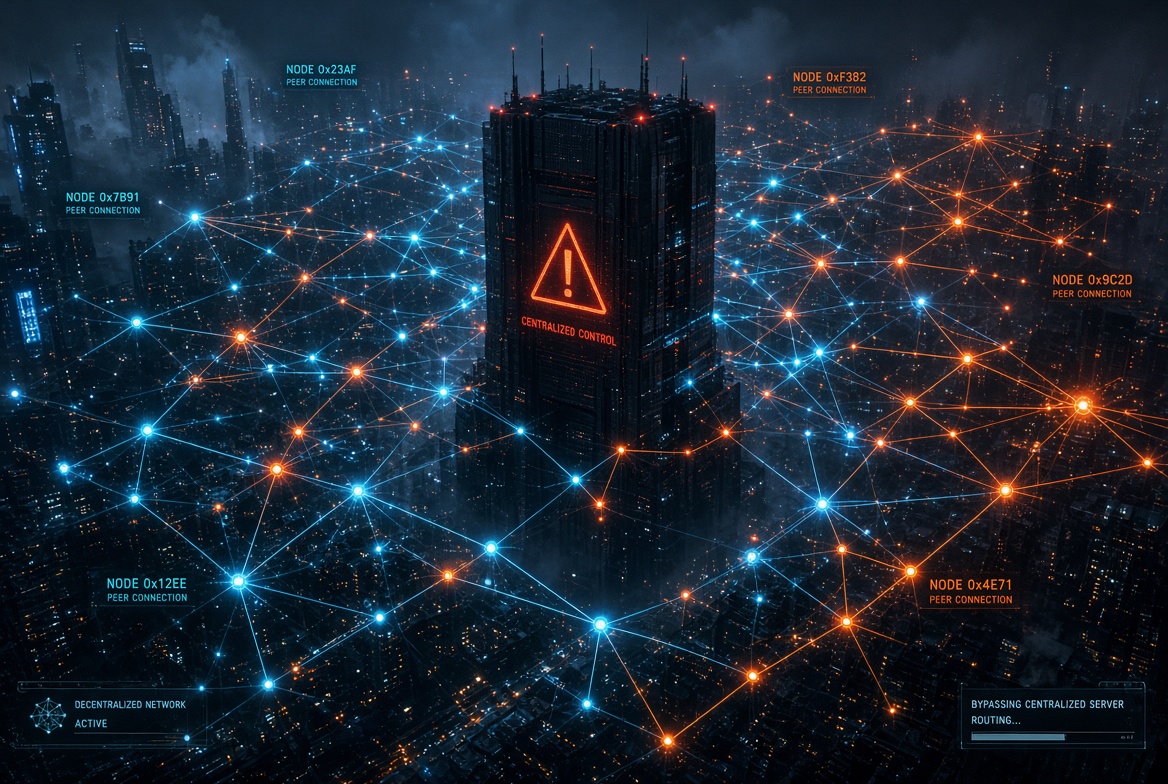
Centralized servers are honeypots. Whether it is a massive tech conglomerate harvesting your daily habits or a government demanding backdoor access to infrastructure, the client-server model is fundamentally broken for privacy. If Amazon Web Services (AWS) or Cloudflare experiences an outage—or worse, complies with a subpoena—your digital life and assets can disappear in a keystroke. The traditional internet relies on these centralized choke points, making censorship and mass surveillance not only possible but inevitable. The only mathematical and structural solution to this vulnerability? Peer-to-peer (P2P) architecture.
The Architecture of Sovereignty: Client-Server vs. Peer-to-Peer
To understand why P2P is revolutionary, you must first recognize the fragility of what you currently use. In a standard client-server model, you (the client) request data from a central server. This server holds all the power. It authenticates you, routes your data, logs your IP address, and decides whether you are granted access. It is a massive single point of failure (SPOF). For deeper insights into securing your foundational setup, you might want to review our guide on [LIEN_A_AJOUTER : digital sovereignty basics].
Peer-to-peer networks destroy this hierarchy. In a P2P model, there are no central servers. Every participant (or “node”) in the network acts as both a client and a server. You request data from the swarm, and you provide data to the swarm. If one node goes offline, the network routes around the damage. It is a hydra; cut off one head, and the network continues to operate seamlessly. This decentralized approach eliminates choke points, making it exponentially harder for adversaries to shut down communication, trace origins, or censor information.
Uncensorable Finance: The Role of Monero and Bitcoin
The most famous implementation of P2P technology is in the realm of digital finance. Traditional banking relies on centralized ledgers. A bank, or a government, can freeze your assets, block transactions, or seize your funds with a single database edit.
Bitcoin introduced the concept of a decentralized, P2P ledger where consensus is reached by a distributed network of miners rather than a central bank. However, while Bitcoin is uncensorable, its public ledger lacks total privacy. This is where Monero steps in as the apex predator of financial privacy. Operating on a robust P2P network, Monero obfuscates the sender, receiver, and transaction amount. Because the network is maintained by thousands of independent peers globally, no central authority can blacklist a Monero node or reverse a transaction. It is sovereign wealth in its purest digital form.
Dark Comms: Secure Messaging Without Servers
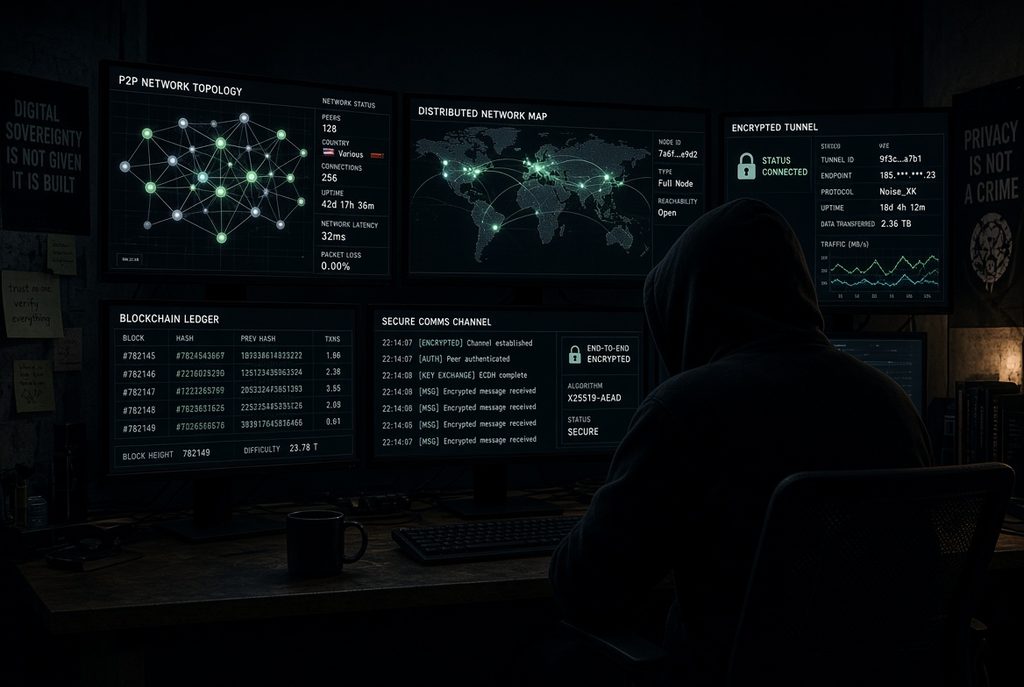
When the grid goes down or authoritarian firewalls go up, traditional encrypted messaging apps fail. Signal, despite its excellent encryption protocol, still relies on central servers owned by AWS to route messages and facilitate contact discovery. If the central server is blocked, communication halts.
The Indestructible Web: IPFS and Decentralized Storage
The modern web is terrifyingly fragile. Link rot, server crashes, and active censorship wipe petabytes of human history from the internet daily. If a hosting provider decides your content violates their arbitrary terms of service, your website is deleted.
The InterPlanetary File System (IPFS) solves this through P2P storage. Instead of locating a file by its location (e.g., a specific server IP), IPFS locates files by their content (a cryptographic hash). When you request a file on IPFS, you aren’t downloading it from one server; you are pulling pieces of it from multiple peers who are hosting that hash. As long as one peer in the global swarm hosts the file, it remains accessible. It makes censorship mathematically impossible and ensures that knowledge outlives the servers that originally hosted it.
We explored the real-world implications of this technology in our cyberpunk thriller, demonstrating how off-grid networks can be the difference between freedom and capture. The Dawn of Resilience Trilogy.
The Ultimate Network Shield: Why Commercial VPNs Are Centralized Traps
This brings us to the most critical vulnerability in modern OpSec: the commercial Virtual Private Network (VPN). Millions of users flock to services like ExpressVPN or NordVPN, believing they are buying privacy. In reality, they are simply shifting their trust from their Internet Service Provider (ISP) to a centralized VPN company.
Commercial VPNs are giant honeypots. All your traffic routes through their centralized servers. If those servers are compromised, monitored by state intelligence, or legally subpoenaed, your data is exposed. A centralized VPN is a single point of failure that fundamentally violates the principles of Zero Trust.
The evolution of network security demands a P2P approach. A decentralized VPN (like RXD Shield) routes your traffic through a distributed network of independent nodes rather than a corporate server farm. By onion-routing traffic through peers, you eliminate the central logging authority. No single node knows both your original IP and your final destination. It is the ultimate network shield, transforming your connection from a predictable corporate tunnel into an untraceable, shifting labyrinth.
Frequently Asked Questions (FAQ)
Are P2P networks legal?
Yes. P2P is simply a network architecture. While it can be used for illicit activities, the technology itself (used for software updates, decentralized finance, and secure comms) is entirely legal and fundamental to a free internet.
Is a P2P VPN safer than a traditional commercial VPN?
Structurally, yes. A traditional VPN creates a single point of failure and relies on blind trust in a corporation. A P2P VPN relies on cryptography, decentralized nodes, and trustless architecture, making mass surveillance and logging exponentially more difficult.
Do I need technical skills to use P2P tools?
Not anymore. While early P2P software was highly technical, modern applications like Session, Monero wallets, and decentralized VPN clients feature user-friendly interfaces designed for seamless adoption.
Conclusion: Decentralize or Surrender
The war for digital privacy is not being fought in courtrooms; it is being fought in network architecture. Centralized systems are inherently designed for control, surveillance, and compliance. As long as you rely on client-server models for your wealth, communication, and connectivity, your sovereignty is an illusion.
Adopting P2P networks—whether holding Monero, messaging via Session, or routing traffic through a decentralized VPN—is the only viable strategy to reclaim your digital autonomy. You must eliminate single points of failure before they are used against you. Decentralize your life, or surrender your data.
Disclaimer: While the threats are real, the methods to fight them are explored through fiction in The Dawn of Resilience.
Moreover, this concentration of data doesn’t just threaten privacy; it exposes the entire economy to a cloud centralization banking collapse risk, making peer-to-peer alternatives essential.