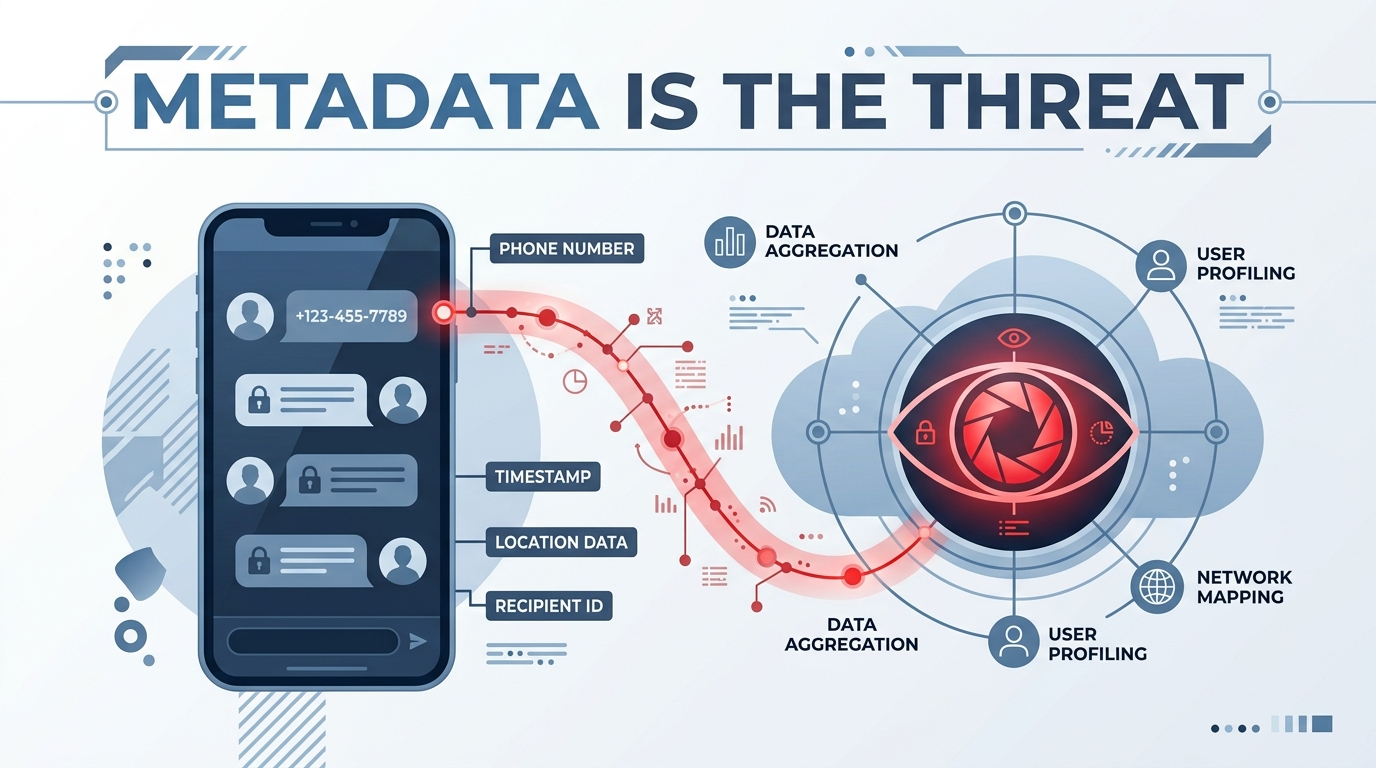
When discussing secure communications, the conversation almost always begins and ends with End-to-End Encryption (E2EE). Most privacy advocates recommend Signal as the gold standard, and for good reason: its cryptographic protocol is virtually flawless. However, cryptography only protects the content of your message. It does not protect the context. In the realm of advanced surveillance, intelligence agencies do not need to read your messages to destroy your privacy. They only need your metadata.
The Signal Vulnerability: Phone Numbers and Social Graphs
Signal is an excellent tool, but it has a critical flaw for complete anonymity. Registration requires a phone number.
A phone number is not just digits. It is a globally unique identifier permanently tied to your real-world identity. In many countries, purchasing a SIM card requires a government-issued ID (KYC). Even if you use a “burner” number, the moment you register for Signal, that number acts as a central anchor.
When you use Signal, the central servers cannot read your messages, but they can see the metadata. They know who you are talking to, when you talk to them, how often you communicate, and the size of the encrypted packets being sent. This creates a “Social Graph.” If law enforcement maps the social graph of a target, they can often infer the contents of the conversations based purely on the timing and frequency of the connections. In short: metadata kills.
As we have repeatedly warned in our analysis of Why a VPN Does Not Protect You From Data Brokers (The OpSec Myth), hiding your IP address is useless if you hand over a persistent identifier.
Enter Session: Decentralized and Anonymous
If Signal is a highly secure vault inside a central bank, Session is a ghost passing notes in a decentralized fog. Session is a fork of Signal, but it strips away the centralized servers and the phone number requirement entirely.
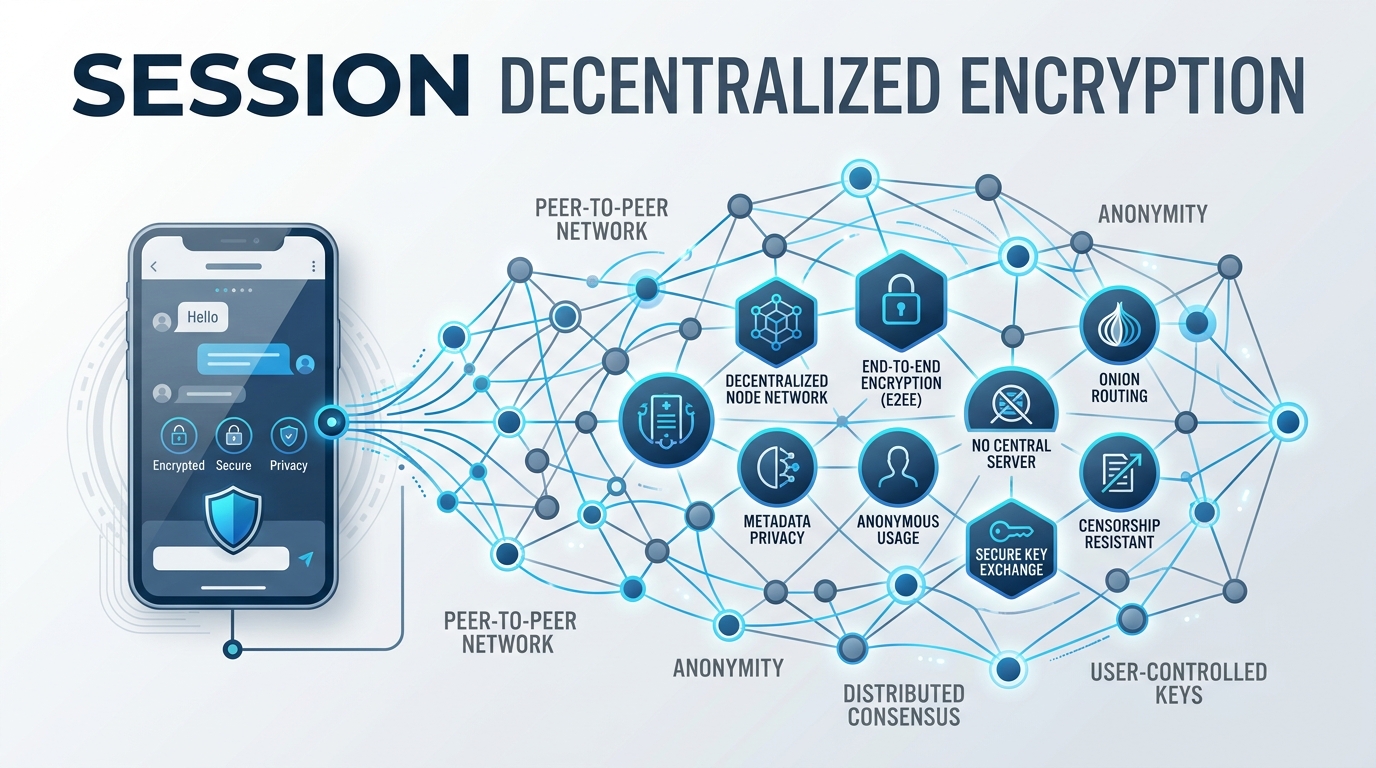
To create an account on Session, you simply generate a randomized “Session ID”—a long string of alphanumeric characters. No email, no phone number, no SIM card required. You share this ID out-of-band with your contacts, completely severing the link between your real-world identity and your communication platform.
Furthermore, Session routes your messages through an onion-routed decentralized network (similar to the Tor network, which powers amnesic systems like Tails OS). There is no central server logging your IP address or building a social graph of your metadata. The nodes routing your message do not know both the sender and the receiver; they only know the next hop. This effectively neutralizes the metadata threat.
The Trade-offs of True Sovereignty
Absolute privacy always comes at the cost of convenience. Because Session does not have a central server to instantly push notifications to your phone, messages can sometimes be delayed. Voice and video calls are currently routed over a peer-to-peer connection that can expose your IP address if you are not careful (which is why you should route it through a VPN).
For communicating with family and friends, Signal remains the most practical and secure choice. But for high-risk operations, anonymous sourcing, or establishing a truly untrackable line of communication, Session is the superior tactical asset.
We explored the real-world implications of metadata surveillance and untrackable communications in our cyberpunk thriller. To see how underground operatives use these exact encrypted networks to evade a global surveillance state, dive into The Dawn of Resilience Trilogy.
Frequently Asked Questions (FAQ)
Can someone hack or intercept the session?
Like Signal, Session uses state-of-the-art end-to-end encryption. As of today, no one has broken the cryptographic protocol. The primary risk is not interception in transit, but endpoint compromise (e.g., malware installed on your physical device reading the screen).
Do I lose my account if I switch phones?
Yes, unless you backup your Recovery Phrase. Because there is no phone number or central account, your Session ID is tied mathematically to a recovery phrase generated when you create the account. You must store this phrase securely offline.
Can governments block Session?
It is very difficult. Because Session relies on a decentralized network of nodes rather than a central server domain (like WhatsApp or Telegram), it is highly resistant to censorship and national firewalls.
The Right to Whisper
Privacy is not about hiding illegal acts; it is about the fundamental human right to whisper. When a platform forces you to provide a phone number, it strips away your right to anonymity before you even send your first message. By migrating your most sensitive communications to decentralized, metadata-resistant networks, you starve the surveillance apparatus of the oxygen it needs to track you.
In our cyberpunk survival thriller, The Dawn of Resilience, Aura—an advanced air-gapped AI assisting the protagonist Ethan—routinely intercepts raw metadata logs. When adversaries assume their standard encrypted apps make them invisible, Aura uses timing clusters and packet sizes to map their entire command structure, forcing Ethan to rely strictly on decentralized, phone-number-free networks like Session. To master the art of digital invisibility and understand the enemy’s playbook, dive into their world and read the first chapter for free below.