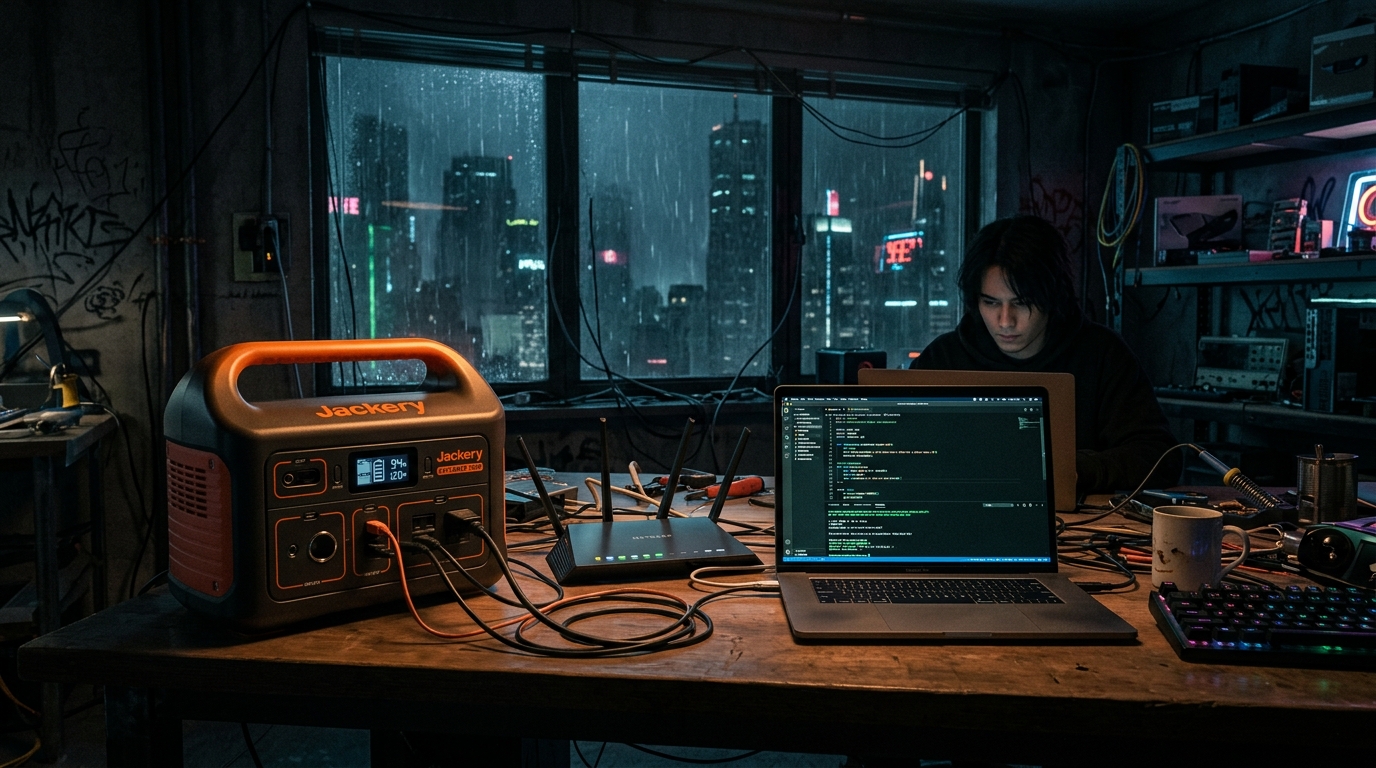
The internet is no longer a luxury; it is the central nervous system of modern survival.
When the power grid fails, the flow of critical information stops. You lose access to emergency alerts, local news, and the ability to coordinate with family.
For the modern urbanite, establishing an off grid internet setup is just as important as stockpiling water.
Without power, your modem and router are useless plastic boxes. Even if your Internet Service Provider (ISP) is still functioning on their own battery backups, you cannot access their network if your local hardware is dead.
We are going to break down exactly how to keep your digital lifeline open using portable solar power, whether you rely on traditional fiber-optic lines or satellite internet like Starlink.
The Fragility of Urban Connectivity
Most people assume their internet will work as long as their phone has battery. This is a dangerous misconception.
During a localized blackout, cellular towers quickly become congested. Everyone in the area jumps on the 4G/5G networks simultaneously, crushing the bandwidth.
Within a few hours, the backup batteries at those cell towers will deplete. When they die, your smartphone becomes a very expensive digital watch.
To maintain situational awareness and digital sovereignty, you must take control of your own infrastructure. You need a reliable, localized way to power your communications.
Powering Traditional Routers and Modems
If you have fiber or cable internet, there is a strong chance your ISP’s local node has a generator or battery backup that will run for several hours—or even days—during a grid failure.
To tap into that surviving network, you only need to power your modem and Wi-Fi router.
The Low-Draw Advantage
The good news is that networking gear draws incredibly little power. A standard modem and router combination typically pulls between 15 and 30 watts.
This means a mid-sized portable power station can run your off grid internet for literally days on a single charge.
You simply unplug your router from the dead wall outlet and plug it directly into the Pure Sine Wave AC outlet of your solar generator. Because these power stations are silent and emission-free, you can safely run them right next to your desk in your apartment.

The Ultimate Failsafe: Starlink and Satellite Internet
What happens if the local ISP infrastructure completely collapses? For true off grid internet, you must bypass the ground-level chaos entirely.
Satellite internet systems, particularly Low Earth Orbit (LEO) constellations like Starlink, offer unprecedented resilience. As long as you have a clear view of the sky, you can connect directly to the satellites, circumventing destroyed local fiber lines and dead cell towers.
Meeting the Power Demands of Satellite Gear
However, satellite internet comes with a catch: it requires significantly more power than a standard router.
A Starlink dish actively tracks satellites and heats itself to melt snow, often drawing between 50 and 75 watts continuously.
To run this system efficiently during a prolonged blackout, you need a robust LiFePO4 solar generator.
By pairing a high-capacity power station with foldable portable solar panels, you create an autonomous, closed-loop communications hub. You pull energy from the sun during the day, store it in the battery, and use it to maintain your off grid internet uplink 24/7.
Discipline and Bandwidth Rationing
Just like rationing food, you must ration your power and bandwidth during a crisis.
Your off grid internet should be used strictly for gathering intelligence, downloading offline maps, and sending encrypted communications to your network.
Avoid streaming high-bandwidth video or engaging in non-essential browsing. The goal is to maximize the uptime of your solar generator and maintain a low digital profile.
True digital sovereignty means not going dark when the city does. Build your communication failsafe today.
Read our full Jackery Review: The Essential Power Station for Urban Survival
FAQ: Off Grid Internet
Can a solar generator run a Wi-Fi router?
Yes. Routers draw very little power (typically 10-20W). A standard portable solar power station can keep a router running for several days, providing off grid internet as long as the ISP’s network is still functioning.
How much power does Starlink use during a blackout?
A standard Starlink setup uses about 50 to 75 watts continuously. To run it reliably as an off grid internet solution, you need a solar generator with at least 1000Wh of capacity, paired with solar panels for daily recharging.
Will my internet work if the power is out in my neighborhood?
It depends on your ISP. Many fiber and cable providers have battery backups at their local nodes. If their node is powered and you have a solar generator to power your home router, your internet will continue to work.
The grid is fragile, but your mind doesn’t have to be. Hardware is only the first step. To truly survive the collapse of our physical and digital infrastructure, you need the right mindset.
Download Chapter 1 of The Dawn of Resilience for FREE and start your journey.