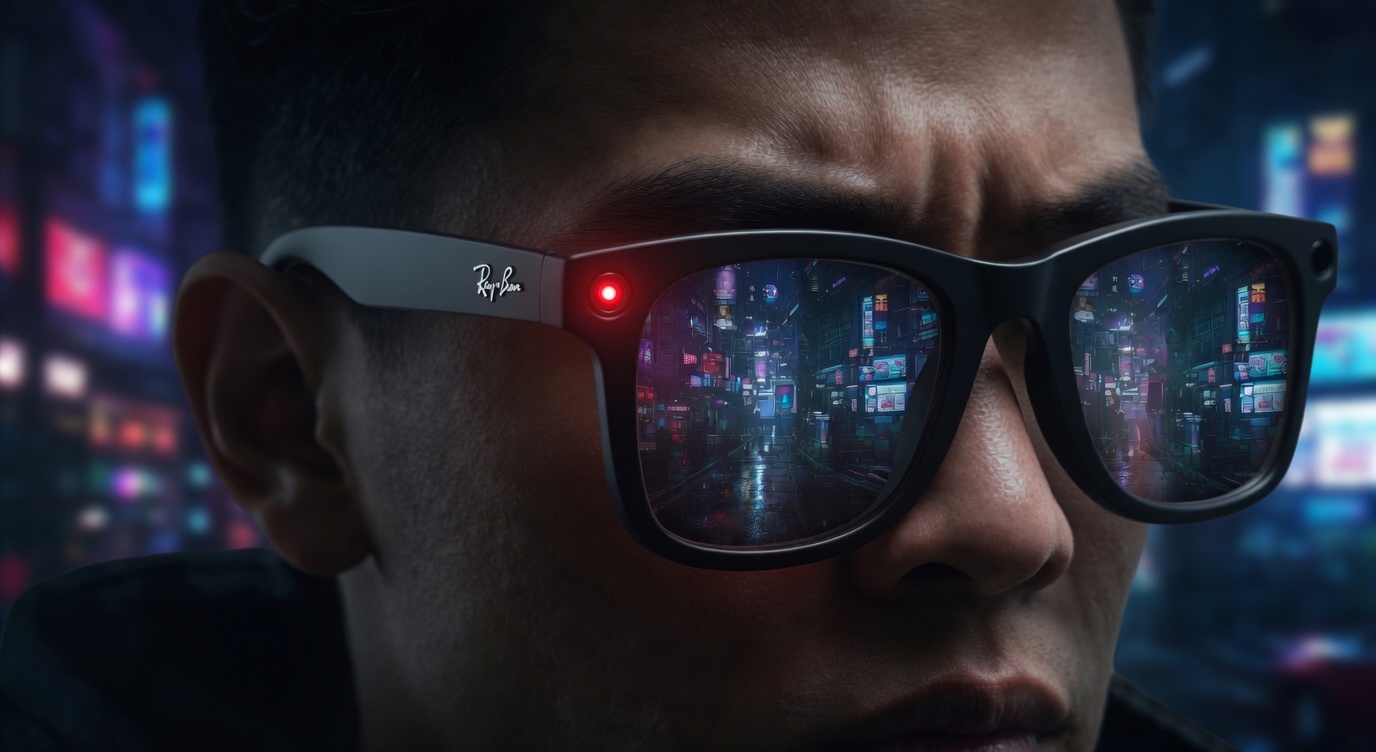
The normalization of wearable surveillance is no longer a dystopian prediction; it’s walking down the street. Smartglasses, notably the Meta Ray-Ban collaboration, have brought high-definition, discreet recording capabilities to the masses. For anyone adhering to the Zero Trust philosophy—a mindset built on the premise of “never trust, always verify”—this development presents a profound challenge. How do you maintain operational security (OpSec) in a world where anyone might be broadcasting your physical reality without your knowledge?
The Illusion of Transparency
Tech companies often point to hardware safeguards to pacify privacy concerns. For the Meta glasses, this is a small, pulsing LED light intended to signal when the camera is recording. In practice, this is a laughable defense.
The indicator light is easily missed in daylight, can be obscured by hair or a hand, and, despite software checks, can often be defeated by a small piece of black tape. We’ve already seen the rise of “prank” channels and dubious “seduction coaches” utilizing these glasses to film non-consenting individuals in malls and public spaces. The threat model has evolved: we are no longer just fighting digital tracking cookies; we are navigating a landscape of constant, physical surveillance. Public anonymity is rapidly eroding.
The Legal Blur: The Jungle of US Privacy Laws
If you think the law will protect you, think again. The intersection of wearable cameras and US privacy law is a gray area heavily reliant on context.
- The Illusion of Public Space: In the United States, the legal standard often hinges on a “reasonable expectation of privacy.” While you generally have no expectation of privacy walking down a public sidewalk, the line blurs instantly when you step into a coffee shop, a boutique, or a semi-private space. Smartglasses seamlessly cross these boundaries.
- The Consent Conundrum: The audio recording capabilities of these glasses are a legal minefield. California, for example, is a “two-party consent” state. Recording a confidential communication without the consent of all parties is a crime. However, enforcing this is nearly impossible when the recording device is disguised as everyday eyewear.
- The CCPA/CPRA Shield: While California leads the nation in digital privacy with the California Consumer Privacy Act (CCPA) and the California Privacy Rights Act (CPRA), these frameworks primarily regulate how companies like Meta process and sell your data. They offer little immediate recourse against the individual wearer silently filming you. The law regulates the data broker, but struggles to govern the data gatherer.

Culture Clash: Smartglasses vs. Zero Trust
The core tenets of Zero Trust are fundamentally incompatible with ubiquitous, invisible recording devices.
Zero Trust requires controlling your perimeter and knowing exactly who and what is accessing your environment. Smartglasses introduce invisible, unpredictable security breaches into your physical reality. Furthermore, there is a stark asymmetry of information: the wearer knows they are recording, while the target remains oblivious. This is a direct violation of basic OpSec principles.
Ultimately, every video captured feeds the beast. The data doesn’t just stay on the wearer’s phone; it’s funneled into Meta’s servers, refining their AI models—a stark contrast to the true sovereignty offered by Local Air-Gapped AI—mapping social graphs, and feeding the very data brokerage ecosystem we strive to avoid.
Defense Strategies and Urban OpSec
Adapting to this new reality requires actionable strategies. Your threat model must evolve, and blending in using The Gray Man Theory is more crucial than ever.
- Reconnaissance: Train yourself to identify the hardware. Look for the distinct thicker frames of smartglasses and the characteristic posture of a wearer (often staring slightly unnaturally or tapping the frame).
- Reaction: If you suspect you are being recorded and it violates your boundaries, break the interaction. Turn away, obscure your face, or explicitly state your refusal to consent. In two-party consent states, loudly declaring “I do not consent to being recorded” creates a legal record if the audio is captured.
- Post-Incident: Understand the reporting mechanisms of the major platforms. If a video surfaces, use DMCA takedowns or privacy violation reports to force removal.
Conclusion: The Prologue to Resilience
Technology will always outpace legislation. We cannot rely on lawmakers to protect our physical privacy in the age of wearable tech. Digital sovereignty begins with physical sovereignty. Adopting a Zero Trust mindset means recognizing these threats and actively managing your exposure in the real world.
This creeping normalization of constant, invisible surveillance isn’t just a fleeting tech trend—it is the exact precursor to the reality explored in my novel, The Dawn of Resilience. The characters in the book are fighting against a system where this kind of ubiquitous tracking has evolved from a consumer gadget into an inescapable control grid. The threats we see today with smartglasses are just the beta test for their dystopian present.

Want to see where this path ultimately leads, and how a Zero Trust mindset can keep you off the grid? Download Chapter 1 of The Dawn of Resilience for FREE right here and discover why preparing today is your only defense for tomorrow.