Location tracking is no longer just a helpful tool for finding the nearest coffee shop or navigating a new city. It has evolved into a massive data extraction industry. Every step you take, every store you visit, and every route you drive is meticulously recorded, analyzed, and sold by data brokers.
For individuals who prioritize their operational security (OpSec)—whether they are investigative journalists, corporate executives, or simply citizens who value their privacy—disabling this tracking is a top priority.
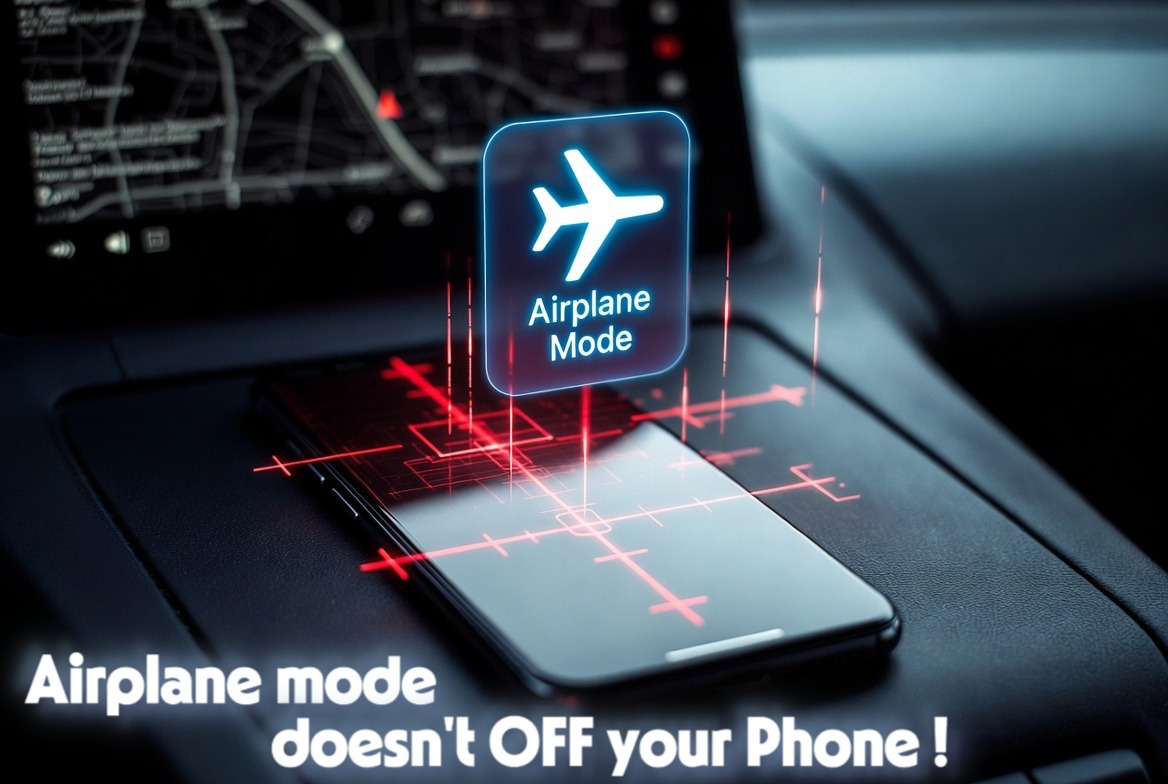
However, there is a dangerous and widespread illusion that achieving digital invisibility is as simple as tapping the “Airplane Mode” icon on your screen. In this article, we will dissect the technical reasons why Airplane Mode is a privacy sieve and explain the physics required to truly stop location tracking.
The Illusion of Airplane Mode
What actually happens when you activate Airplane Mode? Historically, it was designed to cut power to the device’s cellular radio transmitters to prevent interference with commercial aircraft avionics. It shuts down your ability to make traditional phone calls or use mobile data.
Crucially, however, modern operating systems often leave the Bluetooth, Wi-Fi, and GPS receivers active in the background. This is not a bug; it is a feature designed by tech monopolies to maintain their data pipelines.
Consider “Crowdsourced Location” networks like Apple’s “Find My” or Google’s equivalent systems. Even if you remove your SIM card and activate Airplane Mode, your device silently “pings” nearby smartphones via low-energy Bluetooth. These surrounding devices detect your phone’s unique identifier and upload its coordinates to the cloud. You are actively triangulated by the network of strangers around you.
The only way to natively limit this deep, OS-level telemetry is by abandoning mainstream operating systems entirely. As we detailed in our guide on The Burner Reborn, utilizing a custom, privacy-hardened operating system like GrapheneOS is required to achieve true software sovereignty.
Furthermore, your phone is packed with embedded sensors—gyroscopes, accelerometers, and altimeters—that continue to record your movement data even when offline. The operating system simply caches this physical movement data and synchronizes it with cloud servers the moment you reconnect to a network.
Wi-Fi Sniffing and Cell Tower Triangulation
The tracking mechanisms extend beyond the device itself and into the infrastructure of public spaces. As discussed in our Airport Cybersecurity breakdown, transit hubs and retail stores utilize passive scanning to track movement.
Even if you are not connected to a Wi-Fi network, your phone’s antenna is constantly shouting its unique MAC address, searching for familiar networks it has joined in the past. This passive exposure makes digital nomad cybersecurity against public Wi-Fi and Bluetooth scanners a critical priority. Retailers and airports use networks of routers to intercept these shouts, effectively mapping your physical path through their buildings.
Then there is the “Silent Ping.” Due to the architecture of modern cellular networks and emergency response requirements (like E911), a smartphone that is supposedly offline or in Airplane Mode may still briefly “negotiate” with a nearby cell tower during a reboot or an emergency broadcast check. These split-second handshakes log your device against a specific geographical tower, permanently recording your location at that timestamp.
The Physics of Invisibility: Faraday Isolation
If you want to assert true physical sovereignty and stop location tracking, you cannot trust software. Software is designed by corporations whose business model relies on your data; the software is designed to betray you.
You must rely on physics. The only guaranteed method to achieve absolute location invisibility is through the use of a military-grade SLNT Faraday pouch.
A Faraday bag utilizes a continuous mesh of highly conductive materials to create a cage around the device. This cage acts as an impenetrable shield against electromagnetic radiation. When you seal your smartphone inside, you cut off all frequencies: cellular, Wi-Fi, Bluetooth, and crucially, GPS (L1/L2 bands).

Because the weak microwave signals from GPS satellites in orbit cannot penetrate the conductive mesh, the phone’s internal chip cannot lock onto a location. Simultaneously, the bag prevents the phone from broadcasting its MAC address to local Wi-Fi sniffers or performing Bluetooth handshakes with nearby devices.
For travelers, executives, or anyone refusing to allow data brokers to map their daily commutes, this physical isolation is indispensable. It transforms your device from an active beacon into a dead block of metal and glass until you explicitly decide to reconnect.
🛡️ The Arsenal: Become Untraceable
Your physical location is your most intimate data point. Do not trust a software toggle designed by Silicon Valley to protect your privacy. Become untraceable on demand with physical electromagnetic shielding.
👉 Discover our selection of premium SLNT Faraday Bags in The Arsenal
FAQ: Escaping the Tracking Grid
Does turning off location services in settings stop tracking?
No. Disabling “Location Services” merely prevents third-party apps (like Google Maps or Uber) from accessing the GPS API. It does not stop the base operating system from triangulating your location via Wi-Fi networks, nor does it prevent your cellular provider from tracking your phone’s connection to their towers.
How does a SLNT Faraday bag block GPS signals?
GPS signals are transmitted from satellites over 20,000 kilometers away. By the time they reach Earth, these signals are incredibly weak. The tightly woven metallic mesh of a SLNT Faraday bag easily absorbs and dissipates these weak microwaves, making it physically impossible for the GPS receiver inside the phone to lock onto a satellite signal.
Can a phone record my location offline and upload it later?
Yes, this is standard practice. The phone caches data from its internal sensors (accelerometers, altimeters) and logs nearby Wi-Fi network names while offline. The moment you disable Airplane Mode, it uploads this batch of data to the cloud, retrospectively mapping your journey. A Faraday bag prevents the phone from gathering external environmental data (like Wi-Fi nodes) during the trip.
In Conclusion
The reality of modern consumer electronics is simple: if a device has a battery, it can be tracked. The convenience of GPS and cloud connectivity has completely eroded personal location privacy. To regain control over your physical movements, you must recognize that software toggles like Airplane Mode are insufficient. True location privacy demands that you replace the software switch with an absolute, physical boundary.
📚 Go Further: The Dawn of Resilience
Becoming invisible on the digital map is the first lesson in reclaiming your autonomy. But what happens when the grid that powers that map collapses completely?
Learn how to survive outside the system in The Dawn of Resilience.