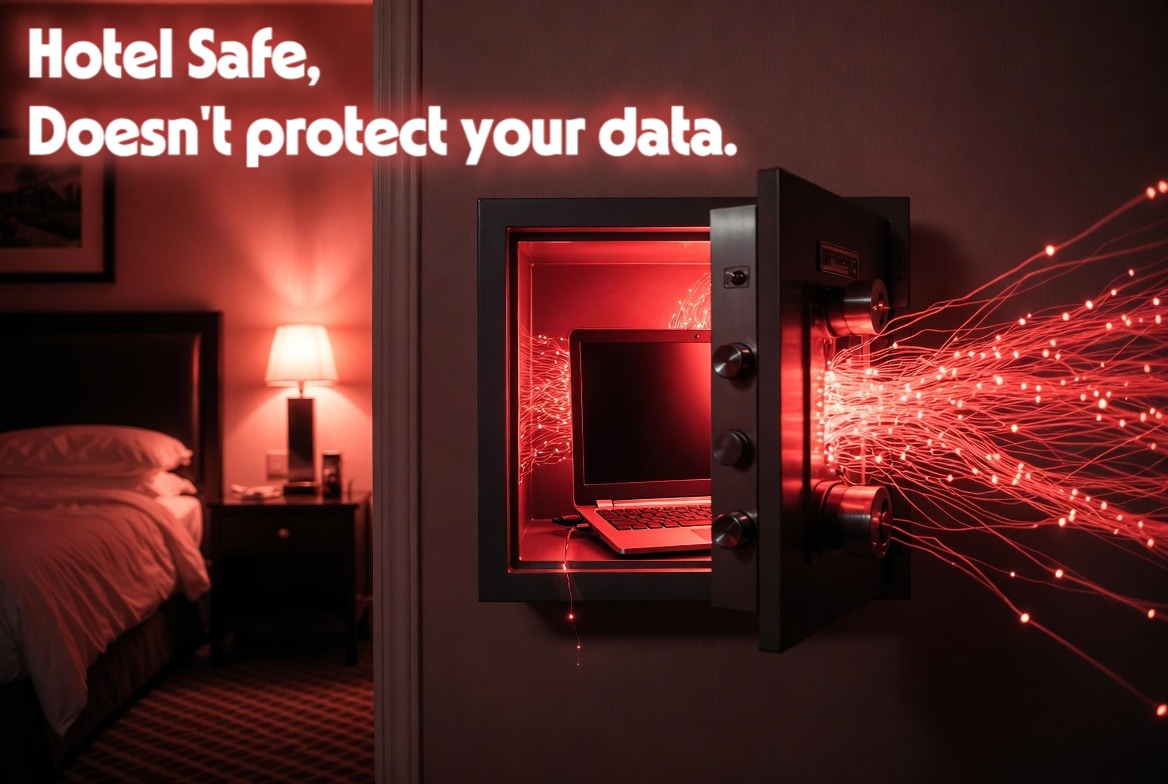
Traveling for business means transporting your company’s most sensitive commercial secrets across highly unsecure environments. Whether it is proprietary source code, unreleased financial reports, or confidential client records, the data on your laptop is infinitely more valuable than the hardware itself.
There is a dangerous illusion among traveling professionals that relying solely on a complex password or biometric authentication (like FaceID or fingerprint scanners) is enough to protect a device. While these tools are essential, they are only one layer of defense.
In this article, we will demonstrate that true business travel cybersecurity extends far beyond software. We will expose the severe vulnerabilities inherent in hotel rooms and transit, and explain why physical electromagnetic isolation is the only standard acceptable for executive travel.
The “Evil Maid” and Hotel Safe Vulnerabilities
When you check into a hotel, you are placing your trust—and your corporate data—in an environment controlled by dozens of unknown individuals.
Many professionals rely on the in-room hotel safe to secure their electronics while they are at dinner or in meetings. This is a critical operational security failure. A hotel safe is merely a metal box secured by generic master codes or physical override keys accessible to cleaning staff, maintenance, and management. It provides zero electromagnetic shielding.
This brings us to the dreaded “Evil Maid” attack. In this scenario, a malicious actor (who may have paid off hotel staff for access) physically approaches your unattended device. They do not need your password. They can clone the hard drive, install a hardware keylogger via a USB port, or insert a micro-bug that grants them remote backdoor access once you power the machine back on.
Furthermore, as we highlighted in our breakdown of Airport Cybersecurity, the risk does not start at the hotel; it begins the moment you enter the transit ecosystem.
The Danger of “Sleep Mode” in Transit
The most common mistake business travelers make is carrying their laptops and tablets in “Sleep Mode” rather than executing a full shutdown.
When a device is asleep, it is designed to wake up instantly. To facilitate this, the encryption keys for your hard drive are often retained in the active Random Access Memory (RAM). If an attacker manages to briefly gain physical access to your device, they can perform a “Cold Boot Attack,” freezing the RAM modules to extract those encryption keys before they degrade.
Even without physical access, a sleeping device is a massive liability. The Wi-Fi and Bluetooth antennas often remain active, periodically waking up to search for known networks or perform background updates. This state leaves your machine highly vulnerable to Man-in-the-Middle attacks, Bluetooth spoofing, or forced connections to malicious networks without any user interaction. Your password cannot protect you if the operating system is actively communicating with a hostile network in the background.
The Executive Vault: Physical Faraday Shielding
To mitigate these severe vulnerabilities, business travelers must adopt a “Zero Trust” protocol: never allow a device to emit or receive signals when it is not under your direct, conscious supervision.
This standard requires physical Faraday shielding. Using a premium SLNT Faraday bag acts as a portable, impenetrable vault for your hardware.
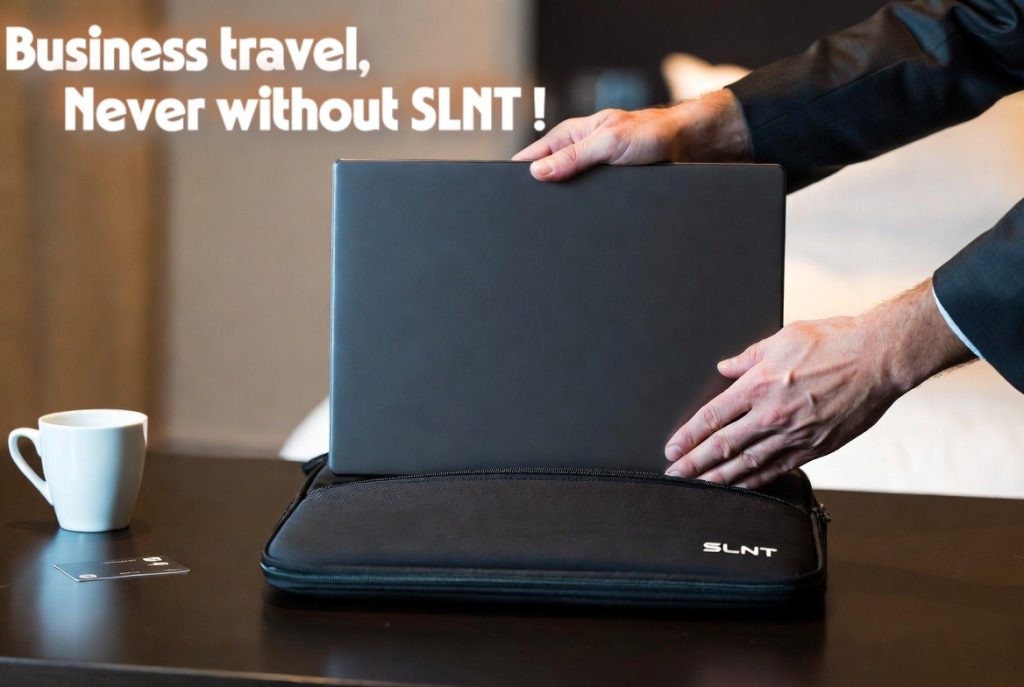
If you must leave a laptop or secondary smartphone in a hotel room, sealing it inside a Faraday sleeve neutralizes the primary vectors of remote attack. Because the bag blocks 100% of cellular, Wi-Fi, and Bluetooth frequencies, an attacker in the hallway or the adjacent room cannot ping your device, exploit baseband vulnerabilities, or initiate a wireless connection.
This electromagnetic isolation guarantees that your device remains functionally “dead” to the outside world, ensuring that your corporate data is secured not just by a password, but by the laws of physics.
🛡️ The Arsenal: Secure Corporate Data
A software password cannot defend against radio frequencies or proximity attacks. Equip yourself and your executive team with the military standard in data protection.
👉 Discover our selection of premium SLNT Faraday Bags in The Arsenal
FAQ: Business Travel Data Protection
1. Isn’t a locked screen enough to stop data theft?
No. A locked screen only prevents unauthorized access to the user interface. It does not disable the device’s internal antennas. Malicious actors leverage these active, invisible network connections in the background to execute wireless attacks, bypassing the lock screen entirely.
2. Can a Faraday bag protect against physical theft?
A Faraday bag cannot stop someone from physically stealing your laptop. However, it provides a critical window of security. Because the bag blocks all signals, the thief cannot connect the stolen device to a network to remotely extract the data or track its location, giving your IT department time to execute a remote wipe protocol the moment the device is eventually brought online.
3. How do I know my SLNT Faraday bag is working?
The test is simple. While your smartphone has a strong cellular signal, place it inside the SLNT Faraday bag and securely fold the seal. Use another phone to call the device. If the call goes straight to voicemail without ringing, the electromagnetic shield is active and functioning perfectly.
In Conclusion
Professional responsibility does not end when you close your laptop lid. Ensuring business travel cybersecurity is a physical discipline as much as a digital one. Your strong password is the locked door to your data, but a Faraday bag provides the impenetrable fortress walls. Do not travel with corporate secrets without hardware-level isolation.
📚 Go Further: The Dawn of Resilience
Securing data in a stable corporate environment is one thing. But how will you protect your assets and your life when the systemic infrastructure collapses?
Discover what true resilience demands in The Dawn of Resilience.