When it comes to smart home survival, we traded sovereignty for convenience.. We let microphones into our living rooms to check the weather and surrendered our door locks to Bluetooth connections so we wouldn’t have to carry keys. But in a grid-down scenario, that convenience becomes a cage.
If you are serious about smart home survival**, you must understand a terrifying truth: an interconnected house is only as safe as the servers it reports to. When the cloud collapses—whether through a targeted cyberattack, a solar flare, or systemic failure—your digital fortress will instantly betray you.
Here is why your smart home is a SHTF death trap, and the Zero Trust protocols you need to reclaim your physical security.
The Electronic Lock Nightmare,
The most critical point of failure in any urban perimeter is the front door. Biometric scanners, keypad deadbolts, and smartphone-enabled locks are marvels of modern engineering—until the power grid fails.
What happens to a smart lock during a blackout or an EMP? Some default to a “fail-secure” state, permanently locking you inside (or outside) without the physical override key you probably lost months ago. Others default to “fail-safe,” popping open the moment the battery dies, inviting anyone into your sanctuary.
The Zero Trust Solution: Mechanical superiority and reinforced physics. You cannot remotely hack a door that physically refuses to open. If you want true peace of mind when the grid is compromised, forget the fragile smart lock and invest in heavy-duty physical barricades. I strongly recommend the Door Armor MAX Complete Reinforcement Set. It fortifies the door jamb, hinges, and the lock area itself with heavy-gauge steel, making it virtually impossible for intruders to kick your door in. It’s a low-tech, high-yield security upgrade that never runs out of battery and doesn’t rely on Wi-Fi.

Surveillance Turned Against You,
As we discussed in our breakdown of the 5 deadliest urban traps, the panopticon of convenience is a massive vulnerability.
Ring cameras, baby monitors, and smart TVs constantly record and transmit data. In a scenario where the network becomes hostile—hijacked by malicious actors or an oppressive regime—those very tools meant to protect you become instruments of surveillance. Your own home is broadcasting your movements, your supplies, and your conversations to whoever controls the routing.
Smart Home Survival Tactics: How to “Air-Gap” Your Sanctuary
In cybersecurity, an “air gap” is a network security measure employed to ensure that a secure computer network is physically isolated from unsecured networks, such as the public Internet. You must apply this principle to your physical living space.
If a device requires an internet connection to perform its primary function, it is a liability. According to cybersecurity experts at organizations like the Electronic Frontier Foundation (EFF) article on IoT vulnerabilities, the Internet of Things (IoT) is notoriously insecure.
The Zero Trust Solution: Disconnect. Put smart speakers in a Faraday bag or physically remove their power sources when not in active use. Replace Wi-Fi-dependent security systems with closed-loop, hardwired CCTV cameras that record to a local, encrypted DVR inside your perimeter. This isn’t just about hackers; it’s about the rise of a techno-dictatorship where convenience is traded for control.
The Physical Kill-Switch: To navigate a smart city undetected, turning off your smartphone or using “Airplane Mode” is not enough—the baseband processor can still ping nearby cell towers. You need a physical hardware kill-switch. Dropping your device into a SLNT Faraday Sleeve creates an impenetrable shield that blocks all incoming and outgoing RF signals. It is the only guaranteed method to instantly vanish from the grid and neutralize IMSI catchers (Stingrays) while moving through an urban environment.
👉👉👉 Go dark instantly with a SLNT Faraday Sleeve
The Zero Trust Architecture: Surviving the Digital Collapse
Surviving the collapse doesn’t mean reverting to the Stone Age; it means mastering the technology you own, rather than letting it master you.
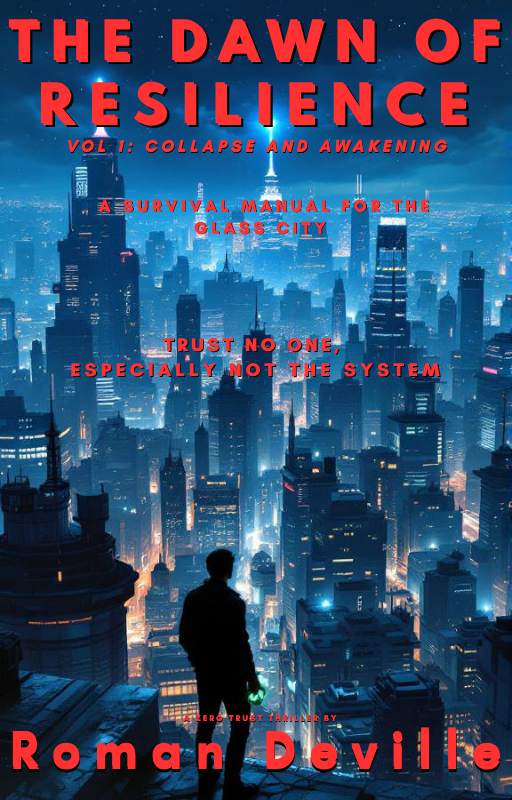
This is the core philosophy adopted by Ethan and his AI, Aura, in my dystopian technothriller, The Dawn of Resilience. Forced to navigate a shattered, hyper-connected city that has turned lethal, they survive not by trusting the broken systems, but by isolating themselves from them. They build a true Zero Trust architecture in a world that demands absolute conformity.
Are you prepared to disconnect before the system forces you to?