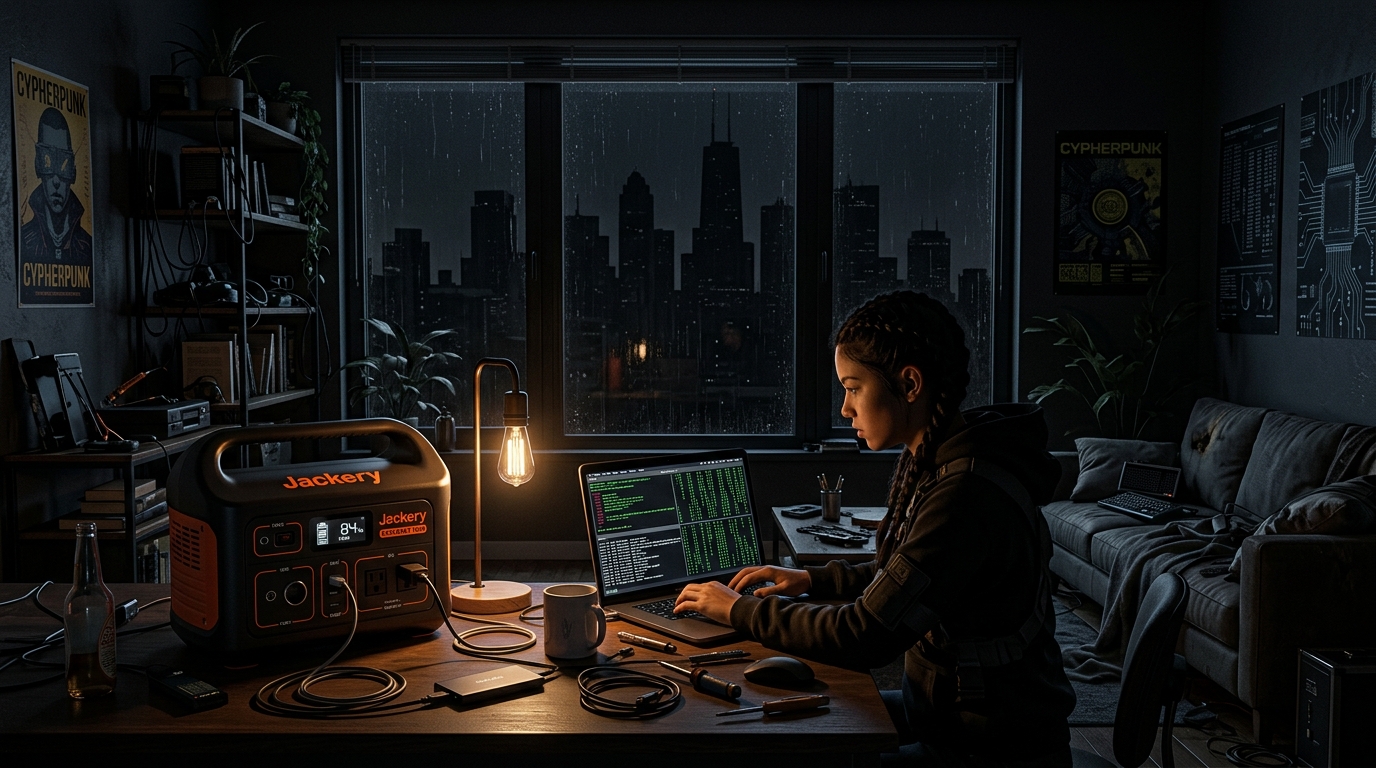
The sudden, deafening silence of a failing grid is a sound every urbanite dreads. When the lights go out in a high-density environment, the illusion of civilization shatters in a matter of hours.
If you live on the fifth floor of an apartment building, the traditional prepper advice of firing up a noisy gas generator isn’t just wildly impractical—it is actively lethal.
True apartment blackout survival requires a radical shift in strategy. You need silent, fume-free, and sustainable power.
In the concrete jungle, where space is a premium and neighbors are a variable you cannot control, portable solar generators are no longer a luxury; they are your absolute lifeline. We are going to dismantle the old myths of urban survival and explain why embracing off-grid solar technology is the only viable path to securing your perimeter.
The Urban Power Grid is a House of Cards
We live in an era of hyper-connectivity, but our physical infrastructure is decaying. Understanding the mechanics of a grid collapse is the first step in apartment blackout survival.
The grid was built for a different century. Today, it faces unprecedented threats: extreme weather events, coordinated cyberattacks on utility substations, and simple demand overloads during summer heatwaves.
Why High-Density Areas Fail First
In a city, everything is interconnected. When a substation blows or a rolling blackout is mandated to save the wider network, millions lose power simultaneously.
Unlike rural areas where residents are accustomed to self-reliance, urban centers descend into chaos rapidly. Water pumps fail, meaning high-rise apartments lose running water. Electronic locks on building doors default to either permanently locked or wide open.
Without electricity, the urban environment becomes a trap. Your strategy for apartment blackout survival must account for the fact that you cannot simply “bug out” immediately.
The roads will be choked, and leaving your secured apartment might be more dangerous than staying put. You need to shelter in place, and to do that effectively, you need autonomous power.
The Lethal Trap of Gas Generators in High-Rises
For decades, the standard response to a power outage was the internal combustion engine. The roaring gas generator sitting in the driveway.
But if you try to apply this rural survival tactic to apartment blackout survival, you will likely kill yourself before the crisis does.
Carbon Monoxide: The Invisible Threat
The most pressing danger of a gas generator is carbon monoxide (CO). It is an odorless, colorless, and tasteless gas produced by burning fossil fuels.
Every year, during winter storms or hurricanes, entire families are wiped out because they placed a gas generator on a balcony, near an open window, or tragically, inside their living room.
In a sealed, modern apartment building, CO accumulates with terrifying speed. There is no safe way to operate a combustion engine inside an apartment. Period.
Even placing it on a small balcony risks the exhaust being blown right back into your living space or your upstairs neighbor’s apartment.
Noise Discipline and Urban OPSEC
Beyond the invisible threat of poisoning, gas generators roar. In a grid-down scenario where desperation grows by the hour, noise is a beacon.
A loud engine announces to the entire neighborhood—and anyone on the street below—that you have power. And if you have power, you likely have food, water, and resources.
For true apartment blackout survival, maintaining Operational Security (OPSEC) is paramount. You must remain a “gray man,” invisible to the chaos outside. Drawing attention to your apartment with a 90-decibel engine is the exact opposite of stealth.

The Solar Revolution: True Apartment Blackout Survival
This is where modern technology changes the paradigm. The advent of high-capacity portable power stations has revolutionized apartment blackout survival.
These units capture energy from portable solar panels and store it safely indoors. There are no emissions, zero noise, and absolutely no volatile fuel to stockpile in a fire-hazard apartment closet.
LiFePO4 Chemistry vs. Traditional Batteries
When selecting a solar generator for your apartment, battery chemistry is critical. Older lithium-ion models are acceptable, but Lithium Iron Phosphate (LiFePO4) is the gold standard for survival.
LiFePO4 batteries are inherently safer, virtually eliminating the risk of thermal runaway (battery fires) which is a massive concern in a high-rise.
Furthermore, they offer thousands of charge cycles. You can drain and recharge a LiFePO4 unit every single day for ten years before it degrades. This longevity is what turns a battery backup into a generational survival tool.
Infinite Cycling with Balcony Solar Panels
Unlike a gas generator that becomes a useless brick the moment you run out of unleaded fuel, a solar generator offers infinite cycling.
During an extended outage, your strategy revolves around harvesting the sun. Foldable, high-efficiency monocrystalline solar panels can be deployed on a balcony, hung out a south-facing window, or even placed on the roof if you have secure access.
You pull energy during the day to run your essential appliances, while simultaneously charging the battery core to get you through the dark night. This closed-loop system is the absolute pinnacle of apartment blackout survival.
Energy Rationing: The 72-Hour Strategy
Owning the hardware is only half the battle; the other half is discipline. You cannot run your apartment as if the grid is still up.
You are not going to power your central air conditioning or your electric oven. Apartment blackout survival relies on ruthless energy rationing.
Prioritizing Refrigeration and Medical Gear
Your immediate priority is food preservation and health. A modern, energy-efficient refrigerator does not need to run continuously.
A robust solar generator can power a full-sized fridge by cycling it on for 30 minutes every few hours. This keeps the internal temperature below the danger zone and saves your expensive stockpile of food.
If you or a family member relies on a CPAP machine or requires refrigeration for insulin, your portable power station is quite literally a life-support system. Because it produces a pure sine wave, it is perfectly safe for sensitive medical electronics.
Keeping Communications and Security Systems Online
Information is your second most valuable asset. When the power drops, you need to know what is happening outside your walls.
Your apartment blackout survival plan must include powering your Wi-Fi router (if the ISP nodes are still functioning), charging your smartphones, and running an emergency Ham radio or NOAA weather radio.
Additionally, if you rely on local security cameras or motion sensors, keeping them powered gives you a vital early warning system against looters.
If you are serious about apartment blackout survival and want a reliable, battle-tested solution that won’t compromise your OPSEC or your lungs, you need to invest in the right hardware before the lights go out.
Read our full Jackery Review: The Essential Power Station for Urban Survival
FAQ: Apartment Blackout Survival
Can I run a solar generator indoors?
Yes, absolutely. Unlike gas generators, solar power stations produce no emissions or carbon monoxide, making them 100% safe for indoor use, which is the most critical factor for apartment blackout survival.
Will solar panels work through an apartment window?
Yes, but with significantly reduced efficiency. Modern low-E window glass blocks a substantial amount of the UV light that solar panels need. For optimal charging during a grid down scenario, you must place the foldable panels on an open balcony or open the window to avoid glass interference.
How long can a solar generator power my fridge during an outage?
It depends entirely on the battery capacity (measured in Watt-hours) and the fridge’s efficiency. A 1000Wh unit can typically run a standard fridge for 7 to 12 hours continuously. However, by utilizing a cycling strategy—running it for short bursts to maintain temperature—you can extend that to over 24 hours of apartment blackout survival.
The grid is fragile, but your mind doesn’t have to be. Hardware is only the first step. To truly survive the collapse of our physical and digital infrastructure, you need the right mindset. That is exactly why I wrote The Dawn of Resilience—a cypherpunk SHTF thriller that explores the brutal reality of urban survival and digital sovereignty.
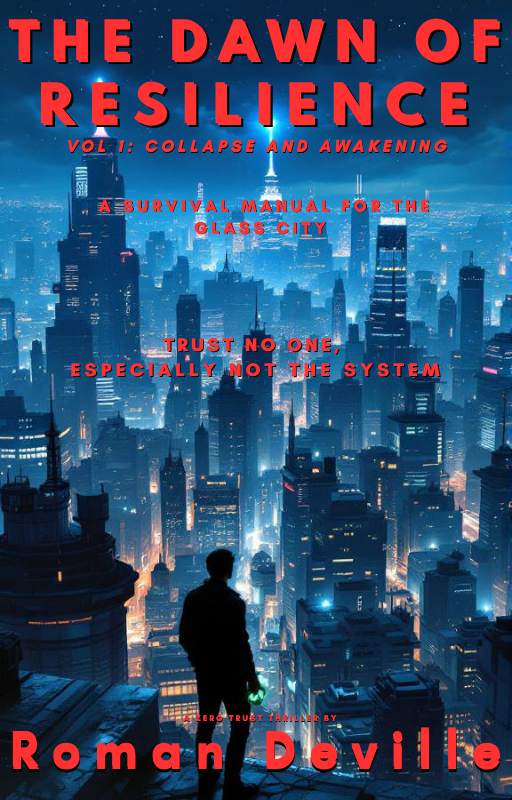
Download Chapter 1 of The Dawn of Resilience for FREE and start your journey.