The art of pickpocketing has evolved. In modern tourist hubs, criminals no longer need to physically touch you or slice open your leather bag to steal your valuables. They just need to stand near you.
We live in a contactless world. From “Tap to Pay” credit cards to biometric e-passports and hotel keycards, the tools we carry rely on constant, invisible radio frequencies to function. While this technology offers immense convenience, it has given rise to a silent epidemic: electronic pickpocketing.
In this guide, we will demystify the mechanics of this invisible threat in crowded tourist zones and provide you with the ultimate tactic for RFID skimming protection to ensure your identity and finances remain untouchable abroad.
The Mechanics of Electronic Pickpocketing
To defend against the threat, you must understand how the technology works. Your modern credit cards and passports utilize RFID (Radio Frequency Identification) and NFC (Near Field Communication) chips. These are “passive” technologies. They do not have an internal power source; instead, they remain dormant until they are “interrogated” by the electromagnetic field of a scanner.
When an authorized scanner (like a store payment terminal) comes close, it powers the chip, which then broadcasts its data.
The attack scenario is shockingly simple. A malicious actor purchases a powerful, portable RFID scanner (often modified to increase its read range) and conceals it in a backpack or jacket. They target dense, crowded environments—such as the London Underground, a bustling Parisian market, or a long queue at a popular monument. The criminal merely brushes past their victim or stands inches away from their pocket.
In less than a second, the concealed scanner powers the chips in the victim’s wallet and harvests the unencrypted data. This can include credit card numbers, expiration dates, and transaction histories, all stolen without a single alarm sounding.
The High-Value Target: Your E-Passport
While having a credit card compromised is frustrating, banks are usually quick to reverse fraudulent charges. However, there is a much more valuable target in your pocket when traveling: your biometric e-passport.
As we noted in our comprehensive guide on Airport Cybersecurity, your identity is the most critical currency when crossing borders. Modern e-passports contain an embedded microchip that stores a digital replica of your biographical data, including your name, nationality, date of birth, and a high-resolution biometric photograph.
A cloned identity is highly prized on the dark web. It can be used to facilitate illegal border crossings, open fraudulent corporate bank accounts, or execute complex spear-phishing campaigns.
Many travelers attempt to mitigate this by purchasing cheap, aluminum-lined sleeves distributed by banks or budget travel stores. This creates a dangerous illusion of security. These low-end “RFID blockers” frequently fail against high-powered or modified scanners used by professional data thieves, leaving the e-passport vulnerable to stealth extraction.
The Tactical Solution: True Faraday Wallets
Effective RFID skimming protection requires moving away from cheap gimmicks and investing in military-grade electromagnetic shielding.
The distinction between a basic RFID blocker and a true Faraday wallet is vast. A premium Faraday wallet utilizes a multi-layered metallic mesh—often incorporating silver and copper fibers—that is specifically engineered and rigorously tested to block the 13.56 MHz frequencies used by passports and credit cards.
When you place your sensitive documents inside a Faraday wallet, the shielding entirely dissipates the energy from an incoming scanner’s interrogation wave. Your cards and passport receive no power, rendering them totally inert. They cannot broadcast a response.
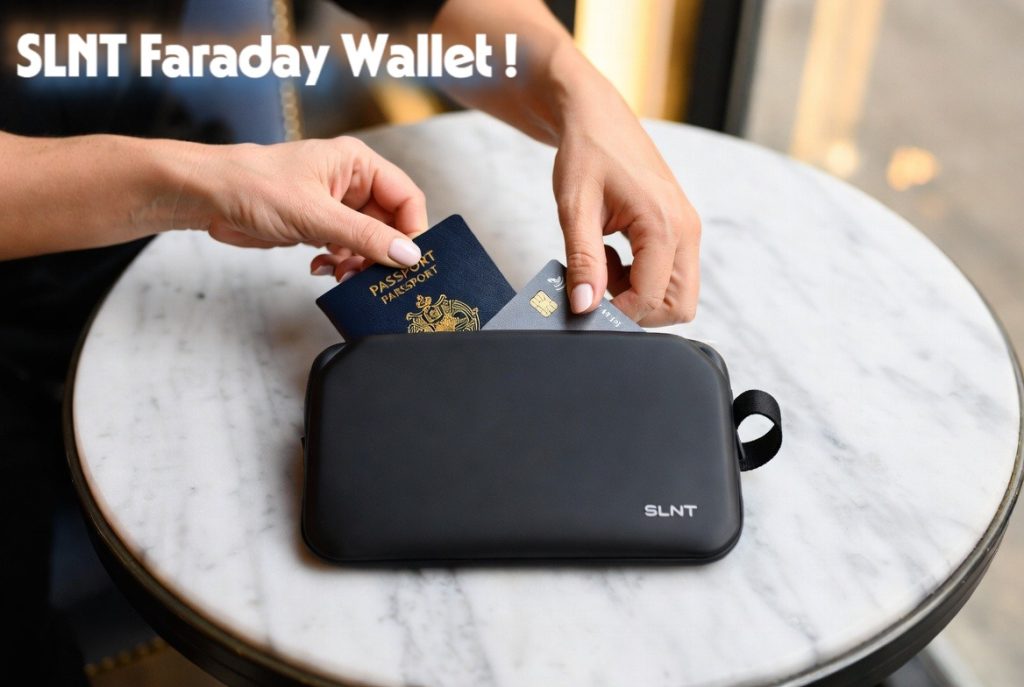
Adopting this tactical solution requires a slight shift in your travel routine. Your e-passport and credit cards should remain strictly sealed inside a SLNT Faraday wallet at all times, only being exposed to the open air at the exact moment you need to hand them to a customs agent or tap a payment terminal. By maintaining this strict physical boundary, you guarantee that your digital identity cannot be covertly siphoned in a crowd.
🛡️ The Arsenal: Secure Your Digital Identity
Your digital identity should not float freely in the air, vulnerable to any passing scanner. Lock down your travel documents in an impenetrable pocket vault.
👉 Discover our selection of premium SLNT Faraday Wallets in The Arsenal
FAQ: Defending Against Electronic Theft
1. Do I need RFID protection if I mostly use Apple Pay or Google Pay?
Yes. While mobile payments (like Apple Pay) use dynamic tokenization and are extremely secure against skimming, you are almost certainly carrying physical backup credit cards and, crucially, your physical e-passport while traveling. These physical items require dedicated electromagnetic shielding.
2. Can RFID scanners steal my data from several feet away?
Generally, no. Standard RFID and NFC skimming requires close proximity—usually within a few inches. This is exactly why electronic pickpockets target tightly packed environments like public transit, crowded elevators, and tourist queues, where close physical contact is normalized and unsuspicious.
3. How is a SLNT Faraday wallet different from a regular leather wallet?
A standard leather or canvas wallet offers absolutely zero protection against radio frequencies; to a scanner, the leather is virtually invisible. A SLNT Faraday wallet integrates a specialized, multi-layered metallic shielding fabric hidden within the design, effectively creating a “Faraday cage” that absorbs and blocks the specific frequencies used to steal data.
In Conclusion
Achieving physical sovereignty while traveling begins with absolute control over your identification and financial documents. In a world where pickpockets use radio waves instead of razor blades, relying on traditional wallets is a profound security failure. Blocking RFID interrogations is not paranoia; it is the baseline digital hygiene required for the 21st century. Lock down your data and travel with confidence.
📚 Go Further: The Dawn of Resilience
Having your identity stolen is a severe micro-level crisis. But are you prepared for a macro-level attack that destroys the entire financial network you rely on?
Discover how to survive when the grid collapses in The Dawn of Resilience.